Number Of Early Childhood Vaccines Not Linked To Autism

A large new government study should reassure parents who are afraid that kids are getting autism because they receive too many vaccines too early in life.

The study, by researchers at the Centre for Disease Control and Prevention, found no connection between the number of vaccines a child received and his or her risk of autism spectrum disorder. It also found that even though kids are getting more vaccines these days, those vaccines contain many fewer of the substances that provoke an immune response.

The study offers a response to vaccine skeptics who have suggested that getting too many vaccines on one day or in the first two years of life may lead to autism, says Frank DeStefano, director of the Immunization Safety Office of the CDC.

To find out if that was happening, DeStefano led a team that compared the vaccine histories of about 250 children who had autism spectrum disorder with those of 750 typical kids. Specifically, the researchers looked at what scientists call antigens. An antigen is a substance in a vaccine that causes the body to produce antibodies, proteins that help fight off infections.

The team looked at medical records to see how many antigens each child received and whether that affected the risk of autism. The results, published in The Journal of Pediatrics, were unequivocal — via redwolf.newsvine.com

Horror frog breaks own bones to produce claws

Amphibian horror isn’t a movie genre, but on this evidence perhaps it should be. Harvard biologists have described a bizarre, hairy frog with cat-like extendable claws.

Trichobatrachus robustus actively breaks its own bones to produce claws that puncture their way out of the frog’s toe pads, probably when it is threatened.

David Blackburn and colleagues at Harvard University’s Museum of Comparative Zoology, think the gruesome behaviour is a defence mechanism.

The researchers say there are salamanders that force their ribs through their skin to produce protective barbs on demand, but nothing quite like this mechanism has been seen before.

The feature is also found in nine of the 11 frogs belonging to the Astylosternus genus, most of which live in Cameroon — via redwolf.newsvine.com

The Executive / Datamancer

The Executive / Datamancer

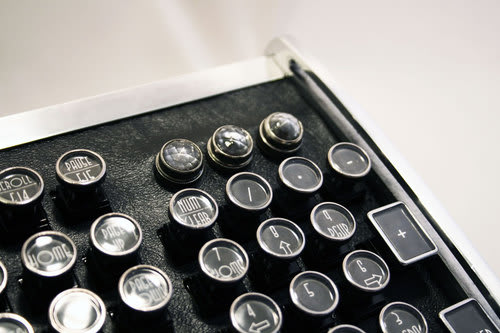
The Executive is an all aluminium polished keyboard with a clean black and silver theme. The elements of this wonderfully hand crafted keyboard declare confidence and boldness — traits typically reserved for people of great attainment. Just as a company’s executive defines the success of the business, the Executive keyboard defines the success of one’s work space — via Etsy

Amazon Is Buying Goodreads

Noted online bookstore and retailer Amazon is buying the excellent online books-related social network and information portal Goodreads. Well, that’s a deal that makes a lot of sense.

For those of you who aren’t familiar with Goodreads, the online books portal is a place where users can connect with each other and keep track of the books they’re reading as well as what they’d like to read. So, you know, it’s exactly the type of service that Amazon would want to acquire, given that it’s in the business of selling books — via redwolf.newsvine.com

Gay marriage will soon be legal

Within the next two months gay marriage will be legal in New Zealand.

It’s safe to make that prediction because a bill sponsored by Labour MP Louisa Wall is one step away from becoming law with only a third reading needed to enact it.

There have been three votes on the bill, putting it through its first reading, second reading and committee stage – 80-40, 77-44 and 77-43.

It’s unthinkable, and would be unprecedented, for a majority that strong to be overturned between a committee stage and a third reading.

The bill is in its final form, no further attempts can be made to amend it.

There were attempts, during its committee stage on Wednesday night, and they were all defeated by at least 80 votes — via redwolf.newsvine.com

USPS Discriminates Against Atheist Merchandise

Suspecting that their strongly branded Atheist products may be treated differently by more religiously-oriented postal regions, Kickstarter success Atheist Shoes conducted an experiment. They sent 178 packages to 89 people in different parts of the US, each person receiving one package prominently branded as Atheist merchandise, and one not. The results: packages with the atheist label were nearly 10 times more likely to be lost, and took on average 3 days longer to show up when they did. Control experiments were also done in Europe and Germany — it’s definitely a USPS problem — via Slashdot

Biggest DDoS Attack Ever Hits Internet

It’s one for the history books. In what security experts are describing as the largest cyberattack in history, the world’s Internet is being slowed down by a battle over spam.

At least five countries reportedly have investigators looking at the slowdown, and there is growing concern that the impact could affect worldwide commerce. Geneva-based Spamhaus, a non-profit organisation that fights spam, recently put on its blacklists a Dutch hosting service, called Cyberbunker.

Spamhaus’ blacklists are intended to help e-mail providers and others filter out spam by identifying the hosting sources. The non-profit organization said that it is under a massive Distributed Denial of Service (DDoS) attack by Cyberbunker, as reprisal for the blacklists — via redwolf.newsvine.com

Want faster fibre? Get rid of the glass

One of the most irritating expressions people can use, broadband at the speed of light, is a little closer to coming true thanks to researchers from the University of Southampton, who have demonstrated air-filled fibres with propagation happening at 99.7 percent of c.

By getting propagation speed up to 99.7 percent from 70 percent of light-speed, the best-case trip from Australia to the US would be cut from about 43 milliseconds to about 30 milliseconds (ignoring router hops and regeneration). In the world of long-distance communications, the lower latency would be beloved of gamers, and also in the world of high-speed financial trading — via redwolf.newsvine.com

19-Year-Old Student Develops Ocean Cleanup Array

19-year-old Boyan Slat has unveiled plans to create an Ocean Cleanup Array that could remove 7,250,000 tons of plastic waste from the world’s oceans. The device consists of an anchored network of floating booms and processing platforms that could be dispatched to garbage patches around the world. Instead of moving through the ocean, the array would span the radius of a garbage patch, acting as a giant funnel. The angle of the booms would force plastic in the direction of the platforms, where it would be separated from plankton, filtered and stored for recycling — via redwolf.newsvine.com

Digg Hints Its Google Reader Replacement Will Go Beyond RSS Alone

Digg today responded to early user feedback about its plans for a Google Reader replacement announced earlier this month, saying that it has narrowed down incoming requests to four key points: keep it simple, make it fast, synchronize across devices, and, finally, allow for easy import from Google Reader, of course. However, the company also hinted at its plans to go beyond just a Reader clone, saying that in future versions, it wants to design a tool that can pull in news and content from other sources, including social media sites, Reddit, Hacker News, and elsewhere.

The Google Reader shutdown has been a boon to several startups, which have gained an influx of new users to their various RSS feed-reading services. Feedly, for example, became the top RSS reader on mobile last week, but it’s too soon to count out competitors like NewsBlur, TheOldReader, Reeder, NetNewsWire and others from gaining traction in the weeks ahead.

Digg meanwhile, now incubated and being rebuilt by Betaworks, is an interesting one to watch in this space, as team members there describe themselves as rabid information addicts who also have relied on Google Reader in the past. But Digg’s involvement is appealing to Google Reader’s heaviest users, because the redesigned Digg.com offers a clean, minimalistic user interface, which is what many want to see in their news reader replacement — that is, they want more of a utility and less of a “news magazine”-styled design.

While it’s good to hear that Digg is listening to what this core crowd wants (some 800 comments were left on the company’s original post, the company says) even more interesting perhaps is what Digg may do with the reader replacement in the future — via redwolf.newsvine.com

Australians don’t know how lucky they are

Last June, Australia celebrated its 21st. No, not a birthday or coming of age, but the completion of its 21st consecutive year of economic growth. Yup, you heard right, 21 years. Of growth. 21.

While the rest of the world lurches from crisis to economic crisis, the land of Oz is powering ahead, enjoying an Aussie dollar at a record high, unemployment at near-record lows (5.4%) and basking in more sunshine than the rest of us can dream up. So what does its Labor government do? Attempt suicide.

Yesterday’s move to oust Australia’s Labor prime minister, Julia Gillard, represents the third attempt by Kevin Rudd (and/or his supporters) to return him to the leadership – a man Gillard beat for the prime ministership in 2010. In the past 10 years, the Australian Labor party has installed and dispatched five national leaders while its nemesis, the Liberal party, has tried four different leaders in just six years.

Viewed from Europe, where national governments are planning to bail out their banks by raiding the savings accounts not just of Russian oligarchs but pensioners too, news of yet another political attack against Australia’s leader smacks of a particular strain of antipodean madness. For decades, it is the British who have worn the whingeing Poms label. Now, it’s time for Australians to accept the malcontents’ mantle, because it is they who appear incapable of seeing just how lucky they are.

Complaint has become the national default position, seen in a political class — and a mainstream media — who spend more time slinging mud or knifing each other than debating and analysing national policy. No other advanced economy can come close to Australia’s 21 years of growth. That period, a full generation, saw governments of both political flavours at the helm in Canberra, and is even more impressive when you remember that it spanned the dotcom boom (and bust), the crisis of 1997-1998 (remember that one?) and the global catastrophe that was the Lehman Brothers crash in 2008. Every single time, opposition parties (again of both persuasions) channelled Chicken Little, warning the sky would fall down in Australia. It didn’t. It still hasn’t — via redwolf.newsvine.com