Ding Dong!: Margaret Thatcher’s foes celebrate death of former PM

Usually, when a public figure dies, even their staunchest enemies briefly suspend hostilities in respect for the dead.

But with Margaret Thatcher that was never going to be the case. She was loathed by too many, for too long.

For some, the wounds left by Thatcher’s Britain are still raw.

By mid-afternoon on the day of Lady Thatcher’s death, the editor of the London Daily Telegraph announced he had closed comments on every Thatcher story.

Even our address to email tributes is filled with abuse, he said — via redwolf.newsvine.com

The Kissinger Cables: WikiLeaks Releases 1.7M Historical Records

The cables are all from the time period of 1973 to 1976. Without droning about too many numbers that can be found in the press release, about 200,000 of the cables relate directly to former US Secretary of State, Henry Kissinger. These cables include significant revelations about US involvements with fascist dictatorships, particularly in Latin America, under Franco’s Spain (including about the Spanish royal family) and in Greece under the regime of the Colonels. The documents also contain hourly diplomatic reporting on the 1973 war between Israel, Egypt and Syria (the Yom Kippur war). While several of these documents have been used by US academic researchers in the past, the Kissinger Cables provides unparalleled access to journalists and the general public. The illegal we do immediately; the unconstitutional takes a little longer —Henry A Kissinger, US Secretary of State, 10 March 1975 — via Slashdot

Sky Email Avalanche Angers Customers

Sky customers are complaining they were bombarded with literally thousands of old email messages when the company switched email provider from Google to Yahoo last week.

Sky has been looking into the issue since Friday, but has so far failed to find a solution — so on Monday afternoon, users are still reporting a flood of old messages. The company’s only advice so far has been to delete the unwanted emails through Yahoo’s cloud client — via redwolf.newsvine.com

The British Library saves the .uk web, starting 20 years too late

A long-running scandal finally ended on Friday with the signing into law of new legislation that allows the British Library and other legal deposit libraries to archive around 5 million websites in the .uk domain. British content on other domains, such as .com and .org, will be added later.

While the legislation is to be applauded, it’s two decades too late to capture the early history of web development in the UK. Massive amounts of valuable data have presumably been lost forever, and there will always be a digital black hole in British history. The consolation is that the Internet Archive, founded by American digital activist Brewster Kahle in 1996, scooped up and preserved some of it in its Wayback Machine.

The British Library has been one of the UK’s copyright libraries since 1662, which means publishers have been legally obliged to give it free copy of everything they print. This has resulted in a priceless archive, albeit one that takes up 500 miles of shelf space.

It would have been logical to make the BL similarly responsible for storing copies of web-based publications as well. If it didn’t feel it had the legal right, or the money, the British government should speedily have provided both — via redwolf.newsvine.com

Waiting for a train that has yet to be built

Gen Okajima is waiting for a train. He knows it won’t arrive soon, not even in the next few years, but he isn’t feeling anxious or impatient. He says it will come once Australia is ready for it.

Mr Okajima, general manager of the Sydney office of Japan’s biggest railway company, is waiting for the day Australia builds a high-speed rail line between Melbourne, Sydney and Brisbane, the subject of a federal government study.

It is his job to ensure that when or if that happens, Australia uses Shinkansen, the bullet trains that carry hundreds of millions along Japan’s great network of high-speed rail lines.

Since the Shinkansen technology is a world-class system, we are proud as a nation, Mr Okajima said. And Australia is such an important friend to Japan we are looking to share its benefit.

This partnership would include sharing research and development costs with the Central Japan Railway Company, Mr Okajima’s employer. But the company has been waiting 26 years for high-speed rail to come to Australia. It opened its Sydney office in 1988. For now, its main line of business is exporting Australian wine and snacks such as beef jerky to Japan to be sold on the Shinkansen — via redwolf.newsvine.com

Dragons colour study could fuel breakthroughs

Dragons colour study could fuel breakthroughs

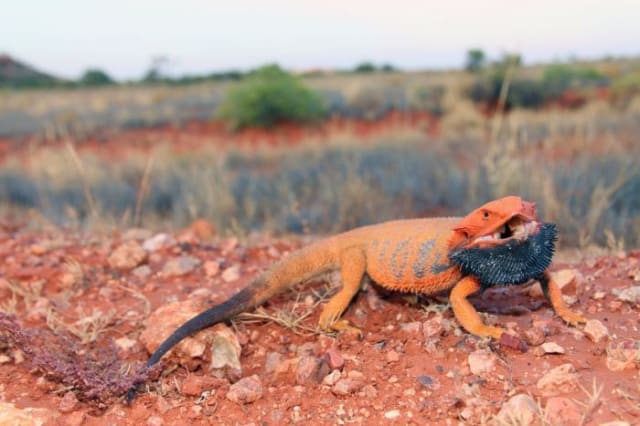
The CSIRO is hoping a new Australian study of native bearded dragons could lead to breakthroughs in medicine and the gathering solar energy.

University of Melbourne scientist Dr Devi Stuart-Fox has just launched a $470,000 study investigating how and why bearded dragons change colours.

They can change colour from almost black, very dark grey, to really bright red particularly when they’re being aggressive with each other, Dr Stuart-Fox said.

What I’m particularly interested in is changes across the full range of solar radiation or solar energy.

From colours that we can’t see like the ultraviolet all the way through to the near infra-red.

Dr Stuart-Fox is hoping to get a clearer understanding of the evolution of colour changing in animals — via redwolf.newsvine.com

Majority of deprivation of liberty cases unreported, says report

Limits placed on the freedom of people with dementia or brain injuries are not being properly recorded, according to a healthcare regulator.

The Care Quality Commission (CQC) said almost two-thirds of applications to restrict a person’s liberty were not reported to it, as required by law.

The CQC said it could signal a lack of understanding or compliance with the Mental Capacity Act.

In some cases, patients had their freedom removed for months at a time — via redwolf.newsvine.com

Cthulhu fhtagn! Indescribably terrifying microbes named for Lovecraft monsters

Suckling unnameable ichor as they slither through the viscous, shrieking madness of the intestinal tracts of lunatic termites, a pair of incomprehensibly monstrous single-celled organisms have been named after the creations of the early 20th century science fiction pulp writer, HP Lovecraft.

A University of British Columbia press release quotes Erick James, a biologist a whose impious explorations into the forbidden have unwittingly revealed a terrifying vista of dread.

When we first saw them under the microscope they had this unique motion, it looked almost like an octopus swimming, said James — via redwolf.newsvine.com

Why I Study Duck Genitalia

In the past few days, the Internet has been filled with commentary on whether the National Science Foundation should have paid for my study on duck genitalia, and 88.7 percent of respondents to a Fox news online poll agreed that studying duck genitalia is wasteful government spending. The commentary supporting and decrying the study continues to grow. As the lead investigator in this research, I would like to weigh in on the controversy and offer some insights into the process of research funding by the NSF.

My research on bird genitalia was originally funded in 2005, during the Bush administration. Thus federal support for this research cannot be connected exclusively to sequestration or the Obama presidency, as many of the conservative websites have claimed — via redwolf.newsvine.com

Capybara / Brevard Zoo

Capybara / Brevard Zoo

Brevard Zoo’s Capybara parents Clancy and Bailey welcomed these three blonde babies on St Patrick’s Day. They are healthy and nursing well. Capybara are herbivores, meaning they eat the leaves of grasses and other plants. They are fussy though, and are known to only eat certain plants and ignore ones they don’t like. Only a week after they are born, baby Capybara can eat grass, although they continue to drink mother’s milk — via ZooBorns

Caesarean hyena cub goes on display

The first hyena cub to be born by caesarean section in Australia has gone on public display for the first time.

The spotted hyena cub was born six weeks ago and has now settled into Monarto Zoo east of Adelaide.

The cub’s five-year-old mother Forest spent three days in labour before vets performed the operation.

Zookeeper Claire Geister says the cub was not breathing when it was delivered and vets feared the worst.

Zookeepers, the vet, the nurses, all of us that were there, we were all on edge. We weren’t expecting it to start breathing again to be honest after three days in labour, she said.

We gave it some medication and it coughed and then it took its first breath and it was getting very strong very quickly after that.

Ms Geister says the hyena’s unique anatomy makes births particularly complex, with only 20 per cent not hampered by complications — via redwolf.newsvine.com