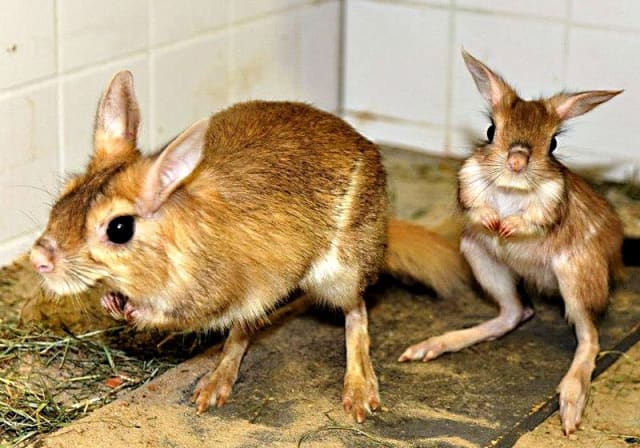
Two South African Springhares hopped onto the scene at Zoo Berlin this winter: One was born on 14 December and the other arrived on 12 January — via ZooBorns
Two South African Springhares hopped onto the scene at Zoo Berlin this winter: One was born on 14 December and the other arrived on 12 January — via ZooBorns

Bilby Faceplant, originally uploaded by Red Wolf.

Speckled Park, originally uploaded by Red Wolf.

A healthy, five-pound tapir was born 1 March at Zoo Salzburg. The sex of the cub has not been determined yet. The first-time mother, Bibi, is taking good care of her cub. Bibi came to Zoo Salzburg last year from Zoo Brno in the Czech Republic — via ZooBorns
Giant squid around the world are basically identical
despite looking very different, say scientists.
The super-sized cephalopods live deep in the oceans and are little-known by the scientific community.
An international team of researchers investigated rare samples of the elusive animals’ DNA to reveal their family secrets.
They discovered that there is just a single species of squid with no population structure.
The findings are published in the journal Proceedings of the Royal Society B — via redwolf.newsvine.com

A 4.5 metre crocodile that had been stalking in waters close to the small community of Palumpa in the Daly River Reserve of the Northern Territory has been captured and shot.
Locals say the crocodile is the one that had been a problem for about two years in the area.
They say — via redwolf.newsvine.com
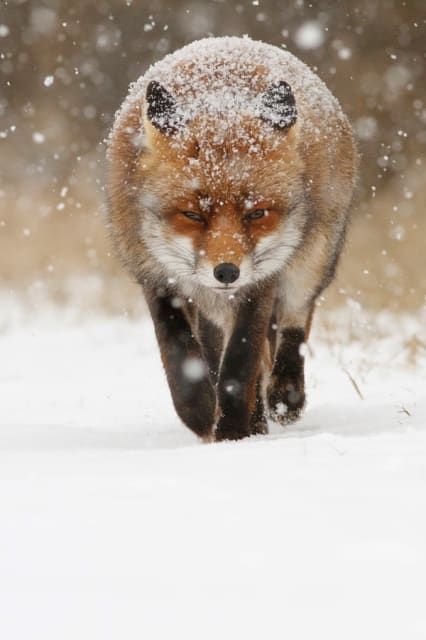
Red fox in the snow — via 500px

Grow Food, Not Lawns posted this image of an ingenious garden made from rain gutters, which are arranged to let water drain down from the top — via MAKE
Sometimes, it seems like science deliberately enjoys springing stuff on you. I was reading through a book by a biology professor, describing the insects in the woods around his home, when the book casually mentioned that they knew certain things about the development of moths because they’d performed brain transplants on them. This seemed to me to be a spectacular instance of burying the lede. Insect development is very nice, but brain transplants are far more electrifying.
The entire process seems to have started in 1923, when a biologist named Walter Finkler reported that he had managed to successfully transplant the heads of insects. He’d been working with water boatmen, meal worms, and common butterflies – both in adult and grub form. The transplantation process was not complex. He’d grab two insects, cut off their heads with sharp scissors, and switch them. The fluid that the insects themselves leaked cemented the new heads in place. After a little time — a 1923 article says a few weeks — the insects were healed up and doing whatever their new heads told them to do. Finkler claimed that the heads of female insects on male bodies continued female behavior, and the head of one species of butterfly kept the habits of its own species, even when its body belonged to a different species — via redwolf.newsvine.com
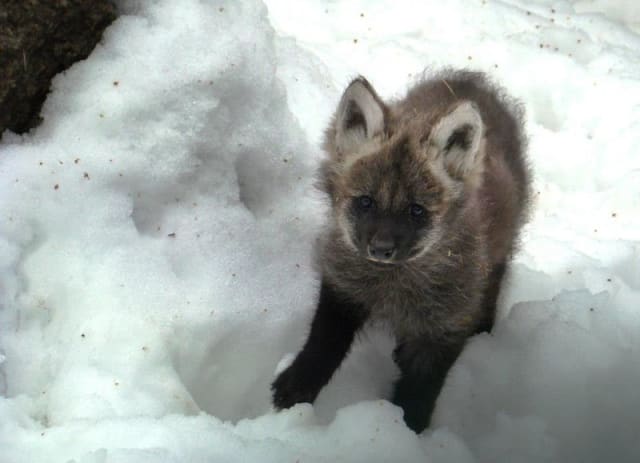
For the first time in its history, Zoo Liberec in the Czech Republic welcomed a litter of Maned Wolf pups to their institution. After a two month gestation, mother Samantha gave birth to four pups back on 10 January. However, after two of the original four litter-mates failed to survive, zoo officials waited to ensure that the second two pups were in good health before announcing the birth to the public — via ZooBorns
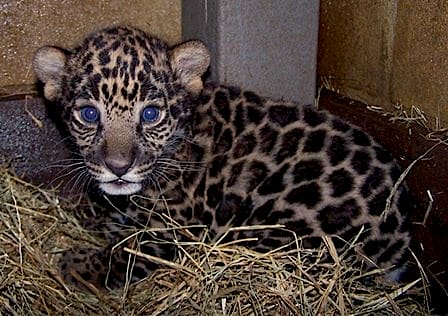
A Jaguar cub was born at Brevard Zoo in Florida on 26 January. The cub, whose sex has not been determined yet, is bonding well with its mother Masaya — via ZooBorns
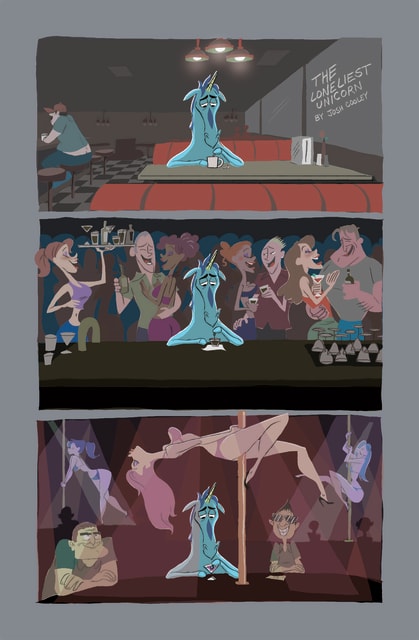
— via COOLEY!

With all those arms, he’s just that much easier to hug! This colourful octopus pillow is sure to make you smile. This pillow is hand printed, stuffed, sewn and will make a great addition to any home or the perfect toy for any child — via Etsy

— via Society6

What do you get when you cross a Meg with a week-long meeting and gridded paper? Prolific doodling of geometrical animals, of course. I drew rectangular creatures of all phyla, but the first one I painted had to be a stack of cephalopods — via CrashOctopus)


 RSS – Posts