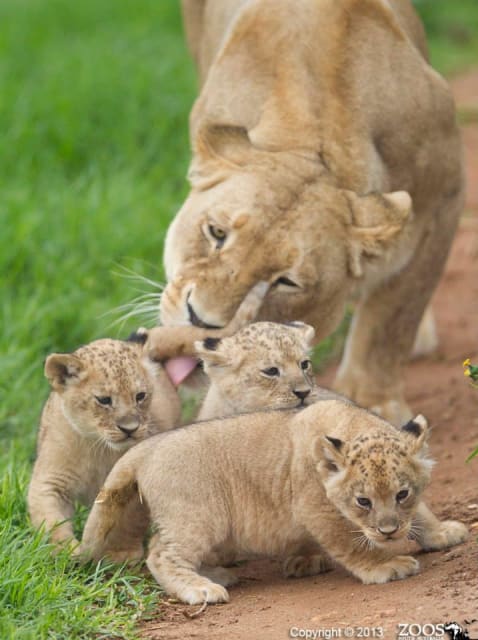
Monarto Zoo recently announced that it has one male and two female lion cubs, whose sex was confirmed during the cubs’ first vet check on the morning of 5 June. It was the first time Monarto Zoo staff had the opportunity to directly interact with the cubs, which were born on 24 April, to review their physical health, administer their first vaccines and determine their sex. The cubs have spent the majority of their time tucked away inside a den being cared for by their mum Tiombe with zookeepers initially keeping their distance to give the new family complete privacy during the important bonding period — via ZooBorns
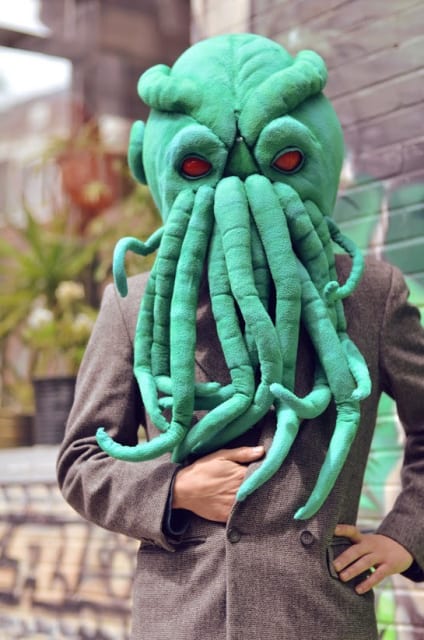
Quirky Montreal artist and fabricator Ian Langohr’s latest creation is this fantastic Cthulhu mask — via MAKE
A group of Southern Tamanduas was imported to the United States last August as part of an effort to bolster the population in US zoos. A pair named Olive and Brutus were placed at the Buffalo Zoo.
Not much is known about the reproductive behaviours of this species, but Olive and Brutus had their first pup on 7 April. The male baby, named Otis, is strong, alert and very vocal — via ZooBorns
As soon as it snows in my country, no wild horses could keep me inside the house. Winter time = fox time! No better view than a healthy and gorgeous red furred fox in a perfect snowy environment. Of course global warming is an awful thing, but yay for our new & improved winters! — via 500px
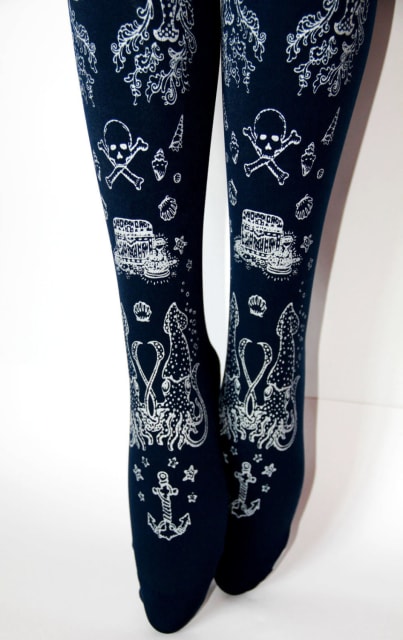
These piratical tights feature pirate ships, treasure and sea creatures octopi, narwhal and squid, hand-printed by Teja Jamilla. These tights are 80 denier, metallic silver ink on deep navy blue tights, design is on the front and goes to thighs — via Etsy

Some people hate Mondays, and now perhaps at least one horse in Barbour County does too.
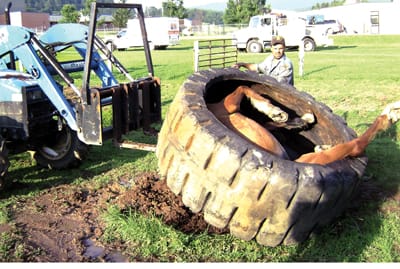
The horse, named Rowdy, fell into a sticky situation Monday when he found himself stuck in a large tyre on a farm in Belington. The tyre apparently holds water for the livestock, and when some local residents found Rowdy stuck, they were afraid he was going to drown.
It is still unclear how the horse found himself in such a mess — via redwolf.newsvine.com
Torrential rain across Gippsland has stirred the local spider population into a web-making frenzy.
The local wetlands between Sale and Longford had nearly dried out before the rains hit last Wednesday and the drier conditions prompted a flush of new growth.
But since the rain started, rising floodwater from the Latrobe and Thomson Rivers has pushed the linyphidea spiders off ground level and up onto drier territory on the top of the grass tussocks, onto fences and into the trees.
In some parts of the wetlands, the web veil covers hectares of flooded grassland — via redwolf.newsvine.com

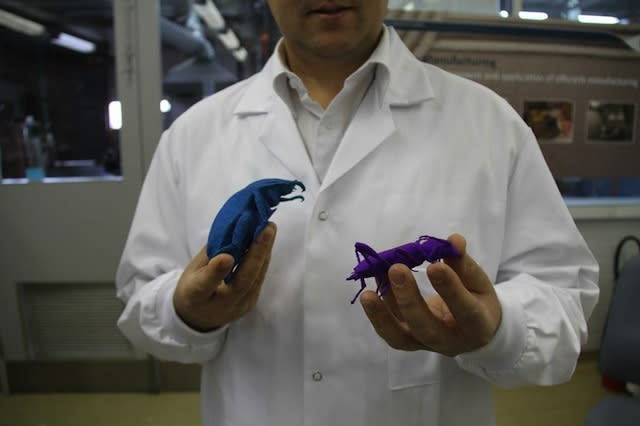
What started out as an art project using the Australian think-tank the CSIRO’s additive titanium 3D printer has turned out to have much more serious application: scaled-up versions of microscopic bugs that make it easier to study their biology.
Originally, the minute insects from the Australian National Insect Collection were scanned, scaled up and printed for a national art exhibition. As CSIRO Science Art fellow Eleanor Gates-Stuart explained: “We combined science and art to engage the public and through the process we’ve discovered that 3D printing could be the way of the future for studying these creatures.”
The process is actually pretty straightforward: the bugs were scanned to produce the CAD files that the printer worked with.
A print run takes about 10 hours, producing a dozen bugs at a time — via redwolf.newsvine.com
Fox cubs having a quiet moment rural Suffolk Vulpes vulpes, originally uploaded by Mike Rae
These are printed with a technique that allows the design to be the same texture as the fabric. The design is IN the fabric, not laying on top of it like with paint, creating a softer feel… it will also not wash out! You can even dye the bandanna to tint the design any colour you want! — via Miss Monster)
Created by famed artist Miss Monster, this bold Cthulhu necklace is a great conversation starter, especially in the city of R’lyeh! — via Hey Chickadee
A surprising suite of microbial species colonizes plastic waste floating in the ocean, according to a new study. These microbes could speed the plastic’s breakdown but might also cause their own ecological problems, the researchers say (Environ. Sci. Technol. 2013, DOI: 10.1021/es401288x).
Plastic waste from consumer products often finds its way into the oceans in a range of sizes, from microscopic particles to large chunks. This accumulation of plastic worries environmental scientists. For example, fish and marine mammals can mistake the plastic pieces for food and ingest the debris, or toxic chemicals can leach from the plastics.
But much still remains unknown about the ecological impacts of these materials. So a group of Massachusetts researchers, led by Linda A Amaral-Zettler at the Marine Biological Laboratory and Tracy J Mincer at Woods Hole Oceanographic Institution, decided to study the microbial communities found on plastics to explore how the organisms affect marine environments — via redwolf.newsvine.com
Karl Dupere-Richer’s cute lamp is made from a suspended globe, garden hoses, a distributor of candy, Christmas balls, caps and lamp a plastic container
. It’s a nice blend of modern and steampunk styles — via Neatorama
Mother’s Day Came early for an endangered Indian Rhinoceros at Tampa’s Lowry Park Zoo. On May 9th—one day before her own birthday, and three days before Mother’s Day—an Indian Rhinoceros named Jamie gave birth to a male calf. The new calf has been given the Indian name Jiyu, meaning “compassionate friend”, by the Zoo’s Asian animal care team. Mother and calf are spending time together off exhibit for the newborn’s safety and for privacy in bonding. After some heavy rains, the two-week old calf loves playing outside in mud puddles — via ZooBorns
— via Pasta be with you
Apple Bloom knows a lot of tricks despite not having her cutie mark yet and she surely doesn’t need the help of the cutie pox just to be good with a loop-de-hoop. Although her highly developed tail dexterity probably rubs off from her big sister, Applejack who in turn is phenomenal with a lasso — via Youtube

Posing Blacky, originally uploaded by Tambako the Jaguar.
Five lively South American Coati babies are keeping their mother busy at the Taipei Zoo. Born on 23 March, the babies progressed in their development quickly, opening their eyes at five days and standing at 12 days — via ZooBorns
Three endangered Malayan Tiger cubs were born at Busch Gardens Tampa on 31 March. The litter consists of two males and one female, each weighing between six and seven pounds. They are currently being monitored around the clock by the park’s animal care team. These newborn cubs will add to the genetic diversity of the Malayan Tiger population and contribute to conservation efforts for the species. Malayan Tigers are Critically Endangered. Scientists estimate that only 500 remain in the wild — via ZooBorns


RSS – Posts