


Sleeping in a Sunbeam, Paw on Ear and Surprise! originally uploaded by Red Wolf
Each member of the squad brings their unique set of skills — via Youtube

Vegemite is set to return to Australian ownership after dairy company Bega announced it would buy most of Mondelez International’s Australia and New Zealand grocery and cheese business.
Bega, in a note to the Australian Stock Exchange, said it would use bank debt to fund the $460 million acquisition.
The deal does not include Philadelphia products but will see Australian ownership of Kraft-branded products, including peanut butter, cheeses and mayonnaise — via redwolf.newsvine.com
NSW Premier Mike Baird has announced his retirement from politics.
In a statement on Twitter, Mr Baird said he was ready to move on from politics after 10 years in public life.
As I have reflected on the approaching halfway mark of our current term of government, and the opportunity it presents to refresh the Cabinet team, I have decided that this is the perfect time for me to hand the reins over to a new Premier,
it read.
Serving as Premier of NSW has been a tremendous honour, but I have made clear from the beginning that I was in politics to make a difference, and then move on.
After 10 years in public life, this moment for me has arrived.
Mr Baird has been Premier of NSW since April 2014, taking over after Barry O’Farrell’s resignation — via redwolf.newsvine.com
Adidas is one of the largest athletic shoe companies in the world, so they have plenty of funding for their advertising campaigns and don’t need to go looking for free submissions from film students.
But Eugen Merher, a 26-year-old student film maker from Germany, decided to submit the ad he’d made for Adidas to their communications department anyway — and found his submission completely ignored.
Determined to show off his hard work despite the cold shoulder he received from Adidas he posted the ad online, where it instantly went viral and gave viewers all sorts of feels — via Youtube
Aggretsuko is a cute Red Panda, working as an office associate in the accounting department of a highly respected trading company. She works in one of the biggest metropolitan areas of Tokyo.
It’s always been a dream of Aggretsuko to work as an accountant, especially in this part of the city. But in reality, her bosses are unsympathetic and give her harsh deadlines. She ultimately has become a pushover within the company. When she gets pushed to the limit, she goes out after work and takes out her frustration and stress with heavy metal Karaoke sessions! — via Youtube
This is one of the best puzzles from Fleb’s collection — via Youtube
Controversial Melbourne evangelical church Catch the Fire, which solicits donations for the Rise Up Australia Party, has had its charitable status revoked by authorities.
The ministries, based in the south-eastern suburbs, have been run by Sri Lankan-born pastor Daniel Nalliah since the late 1990s.
Mr Nalliah launched the Rise up Australia party in 2013 on an anti-Islam, anti-multiculturalism platform and fielded candidates at last year’s federal election.
He openly preaches his political message from the pulpit and collects donations for the party at church services.
As a registered charity, Catch the Fire had access to Commonwealth tax concessions including GST waivers, income tax exemptions and fringe benefit tax rebates.
But the Australian Charities and Not for Profits Commission (ACNC) has now revoked its charitable status. Charities are not allowed to promote or fund political candidates — via redwolf.newsvine.com
A rare pair of cheetah cubs have ventured outside for the first time at Longleat Safari Park. Thirteen-week-old cubs Poppy and Winston, who were named by the public, are the first to have been born at the Wiltshire wildlife attraction, which celebrates its 50th anniversary this year. The pair, both still sporting Mohican-style juvenile fur, were allowed outside to explore their paddock under the watchful eye of mum Wilma — via Youtube
A huge cathedral with tall towers and a magnificent dome rises slowly in the municipality of Mejorada del Campo, 20 kilometres from Madrid. It seems like a common occurrence, but it is not. The building has been under construction for 50 years — brick by brick — by one man: Justo Gallego Martínez, farmer, ex-monk and a self-taught architect of 91 years of age. — via Arch Daily

After a long absence, The Twilight Zone returns with one of the most ambitious, expensive and controversial productions in broadcast history. Sci-fi writers have dabbled often with alternative history stories – among the most common is the What If The Nazis Had Won The Second World War
setting — but this huge interactive virtual reality project, which will unfold on TV, in the press, and on Twitter over the next four years, sets out to build an ongoing alternative present. The story begins in a nightmarish version of 2017 in which huge sections of the US electorate have somehow been duped into voting to make Donald Trump president. It sounds far-fetched, and it is, but as it goes on it becomes more and more chillingly plausible. Today’s feature-length opener concentrates on the gaudy inauguration of President Trump, and the stirrings of protest and despair surrounding the ceremony, while pundits speculate gravely on what lies ahead. It’s a flawed piece, but a disturbing glimpse of the horrors we could stumble into, if we’re not careful — via redwolf.newsvine.com
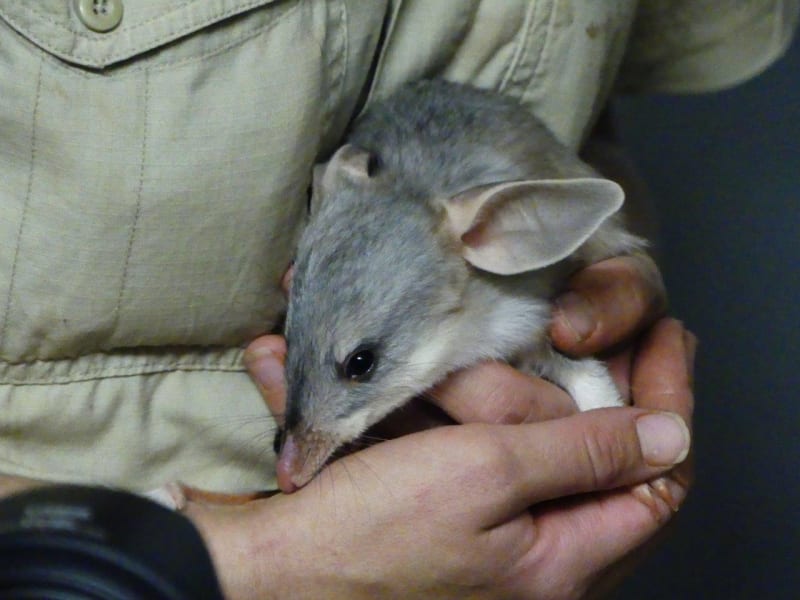
Alice Springs Desert Park, in central Australia, has produced two new resident marsupials.
The Greater Bilby is currently listed as Vulnerable
on the IUCN Red List of Threatened Species, so the birth of the two healthy little male Bilbies puts the Desert Park on the conservation front and helps ensure that the unique marsupial will survive for generations to come — via ZooBorns
Jones Pitsker marbling paper at the Oberlin College Letterpress Studio — via Youtube

If looking
good heads up your list of priorities when it comes to buying a record player, then this Ricatech wooden turntable is well worth investigating.
It looks amazing. Crafted from lacquered wood, the player shows off the natural graining, with the metal detailing very much the icing on the cake. But this isn’t just a pretty face.
It is also a three-speed, belt-drive turntable (33, 45 and 78rpm), with speakers able to unfold
when needed, along with USB output for digitising to PC or Mac, an Audio Technica needle and two AC adaptors (UK and Europe). A carry handle for ease of moving too.
Classy and classic, you can get one for €169 — via Retro to Go

Nail Art: Rainbow Spots originally uploaded by Red Wolf
For years, American Apparel proudly touted its Made in Los Angeles
motto. With its sale Tuesday to a Canadian sportswear firm, neither American Apparel’s name nor its motto will ring so true.
Gildan Activewear agreed to pay $88 million in a winning auction bid for the American Apparel brand and some manufacturing equipment, the company said Tuesday. The deal for American Apparel, which filed for bankruptcy in November for the second time, still requires approval from a Delaware bankruptcy court judge Thursday.
Gildan did not buy any of the company’s 110 retail stores in the US. Those stores are likely to close within a few months, analysts said.
Glenn Chamandy, chief executive of Gildan, said that American Apparel will be a strong complementary addition
to its portfolio.
We see strong potential to grow American Apparel sales,
he said in a statement. There is potential to drive further market share penetration in the fashion basics segment
both in North America and internationally.
Gildan may keep some warehouse and manufacturing operations in Los Angeles, but analysts said that the vast majority of American Apparel factory workers in the Southland will be out of a job. In December, American Apparel notified nearly 3,500 Southland employees that they may lose their jobs. The message went to 332 workers in Garden Grove, 959 workers in South Gate and 2,166 workers at the company’s sprawling headquarters in downtown Los Angeles — via redwolf.newsvine.com

A mid-century style design created in PowerPoint using the basic shapes tool; no clipart
Mid-Century Living Room originally uploaded by OUdaveguy98!
Making a rope from lime bast, the way it’s been done for over a thousand years in Norway.
Ropemaker Ingunn Undrum and boatbuilding apprentice Dennis Bayer head out to harvest the bark of lime trees (linden tree), in the spring when the sap is rising.
The paper thin layers of bast are glued together, and need to soak for a long time in the sea to separate. The water in the Hardanger fjord is cold even during summer, so the bark is soaking until fall, for 3-4 months.
Ropemaker Sarah Sjøgreen lays the bast rope, and makes a traditional carrying rope with three strands, for transporting the cut grass during hay making season. The bast is naturally water proof, and rots very slowly compared to other rope materials. This explains why it has been found intact in viking excavations dating back to the 800s.
The video was recorded by Silje Ensby at Hardanger Maritime Centre, a centre for historic ship preservation, located in Hardanger, Norway — via Vimeo
Lynn Johnston demonstrates making her mother’s Christmas PomPom Bow. All you need is polypropylene ribbon and scissors — via Youtube


 RSS – Posts