Former FBI director J Edgar Hoover had a plan to arrest 12,000 Americans he deemed a possible threat to national security, declassified papers reveal. The FBI chief sent his proposal to US President Harry Truman just after the start of the Korean War in 1950. He asked the president to declare the mass arrest necessary to counter treason, espionage and sabotage
. There is no evidence any part of the plan was ever approved
The web site of the National Bureau of Corruption Prevention (NBCP) crashed on Tuesday, just hours after its launch, as droves of people logged on to complain about corruption among officials. The web site (yfj.mos.gov.cn) was closed for most of the afternoon
First-tier notebook manufacturers are increasing the standard installed memory from the current 1 GB to 4GB. They claim the move is an attempt to shore up the costs of DRAM chips, which are currently depressed because of a glut in market. The glut is supposedly due to increased manufacturing capacity and the slow adoption of Microsoft’s Vista operating system. The proposed move is especially interesting, given that 32-bit Vista and XP cannot access 4 GB of memory. They have a practical 3.1 — 3.3 GB limit. With Vista SP1 it seems that Microsoft has decided to fix the problem by reporting the installed memory rather than the available memory — via Slashdot
Given Apple’s marketing toward the young and the trendy, you wouldn’t expect the US Army to be much of a customer. Lieutenant Colonel CJ Wallington is hoping hackers won’t expect it either. Wallington, a division chief in the Army’s office of enterprise information systems, says the military is quietly working to integrate Macintosh computers into its systems to make them harder to hack. That’s because fewer attacks have been designed to infiltrate Mac computers, and adding more Macs to the military’s computer mix makes it tougher to destabilise a group of military computers with a single attack, Wallington says
The application security researcher Jeremiah Grossman described to CSO magazine how he takes extreme measure to stay safe online. The simplest tip he uses: two separate browsers: One, which he calls the promiscuous
browser, is the one he uses for ordinary browsing. A second browser is used only for security-critical tasks such as online banking. When Grossman wants to do online banking, he closes his promiscous browser, opens the more prudish one, and does only what he has to do before closing it and going back to his insecure browser — via Slashdot
The popular BitTorrent site Mininova officially launched its Content Distribution service, an easy way for indie publishers to share their content with a wide audience, for free of course. All the files published with the new Content Distribution (CD) service will be placed on the frontpage as featured content. The publishers don’t need to have any knowledge about BitTorrent because Mininova will create the torrent and make sure it is seeded
Stanford researchers have found a way to use silicon nanowires to reinvent the rechargeable lithium-ion batteries that power laptops, iPods, video cameras, cell phones and countless other devices. The new version, developed through research led by Yi Cui, assistant professor of materials science and engineering, produces 10 times the amount of electricity of existing lithium-ion, known as Li-ion, batteries. A laptop that now runs on battery for two hours could operate for 20 hours, a boon to ocean-hopping business travellers
MIT scientists have found a way to induce cells to form parallel tube-like structures that could one day serve as tiny engineered blood vessels. The researchers found that they can control the cells’ development by growing them on a surface with nano-scale patterning
Channel9 is reporting that Internet Explorer 8 has correctly rendered the Acid2 page in standards mode
All Australian televisions will have to be digital within five years under the new federal government’s plan. Communications Minister Stephen Conroy says he has taken the first firm steps to ensure the switchover to digital TV is completed by the end of 2013
A 4,000-year-old clay tablet authorities suspect was smuggled illegally from Iraq was pulled from eBay just minutes before the close of the online auction. Criminal proceedings have been launched against the seller, identified only as a resident of Zurich
Researchers in a remote Indonesian jungle have discovered a giant rat that is about five times the size of a typical city rat and a tiny possum
Optus has responded to criticism of the move, saying that if a customer wants to avoid paying excess fees they can choose to limit their usage
. Optus provides a set of tools to help customers manage their data usage including data usage alerts via SMS to their mobile phone free of charge, email notifications and access via the web any time
, said an Optus spokesperson.New Optus Fusion customers could be stung by up to $300 in excess usage fees from today, and Optus subsidiary Virgin Broadband has also increased its Broadband at Home
pricing. Optus Fusion plans were previously a no more to pay
broadband deal, as they were shaped to slower speeds once the allowance of 2GB, 7GB or 20GB was reached
The Organisation for Transformative Works has just launched. It’s a fascinating new proto-nonprofit determined to defend media fandom from the excesses of copyright and to help fanfic writers and vidders maintain control of their remixed works — via Boing Boing
Optus is now offering increased cable broadband speed of up to 20Mbit/s, but only those on the latest MyHome and Fusion plans can get it. The speed is double the up to 10Mbit/s
that was previously offered, and matches Optus’ advertised ADSL2+ speed. But users on old plans will not be able to get the higher speed unless they switch to new, less attractive offers
They’re coming and it will be difficult to get away without having one. Google Profiles will be integrated in most Google services so you have a coherent identity and a simple way to manage your contacts
So, I decided to take the RFID passport out for a spin, and now Neibi and I are in Sapporo, Japan, sequestered in a business hotel opposite Hokkaido University. Outside it’s a bracing -6 degrees celsius.
I will now relate to you the tale of day one.
On the first day, December 14th, we flew from Sydney to Narita (Tokyo international airport). We flew JAL and it was pretty good: the flight left late yet arrived early, we got vegetarian food, and the headrest entertainment screens were absorbing. The chick who checked us in was like an angrier Lee Lin Chin, but she got the job done.
I spent my eight and a half hours playing go (on the headrest: victory by resignation), watching movies (Stardust, enjoyable; and Ratatouille, a competent entry), playing Travel Blokus (with Neibi… we tried to play Ingenious Travel Edition but she dropped the pegs), reading Nabokov (short stories), eating (rice crackers), and playing shogi (on the headrest: defeat by checkmate).
When we landed we got into a tiny train (my head touched the roof) which took us to honour systems customs (“I’d like to declare…” “No, just go through.”). From there we took the famous airport limo bus to Haneda (Tokyo domestic).
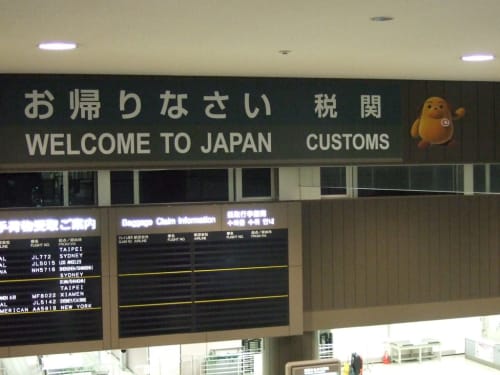
So, the first day was most spent sitting down, but after checking into our hotel (which was nice) we strolled through the industrial ghetto seeking dinner. We found an extremely Japanese street, which was laid out as follows: curry house, medical clinic, hana-ya, yakitori stand, level crossing, McDonalds, Lawson konbini, karaoke bar, soba restaurant. The soba place had a kana / primary school kanji menu so I thought I had a decent shot at ordering our dinner.
We got ooki yasai soba o futatsu, which for some reason had spam in it (“spam, spam, eggs and spam, tenpura and spam”, etc). The patrons mocked us in a friendly fashion. “Dozo”, they said, gesturing to the counter as I fell over trying to remove my shoes. The proprietor was a fan of Australia and kept mentioning Kingusu Kurossu, which he was keen on.
The next morning we ate breakfast at the hotel (an East-West buffet with fruit salad and cold miso), then flew to Sapporo, Hokkaido.
Recent breakthroughs in scramjet engines could mean two-hour flights from New York to Tokyo. This technology, decades in the making, could redefine our understanding of air travel and military encounters. To put things in context, the world’s fastest jet, the Air Force’s SR-71 Blackbird spy plane, set a speed record of Mach 3.3 in 1990 when it flew from Los Angeles to Washington, DC, in just over an hour. That’s about the limit for jet engines; the fastest fighter planes barely crack Mach 1.6. Scramjets, on the other hand, can theoretically fly as fast as Mach 15 — nearly 10,000 mph — via Slashdot
The malware economy is turning into a recognisable traditional IT economy. Leasing botnets? Malware support? Welcome to the new age of computing. One indication of the maturity of the black economy, according to Telafici, was the recent case of a hacker who wrote a packer [software used to bypass antivirus protection], threw in the towel recently as it wasn’t profitable enough — there’s too much competition. They opened the source code and walked away
— via Slashdot
Terry Pratchett, has announced that he has been diagnosed with early-onset Alzheimer’s. The OBE-winning author of the Discworld fantasy series made the original announcement on the web site of Discworld illustrator Paul Kidby. Pratchett remains optimistic: I would just like to draw attention to everyone reading the above that this should be interpreted as ‘I am not dead’. I will, of course, be dead at some future point, as will everybody else. For me, this maybe further off than you think — it’s too soon to tell
— via Slashdot


 RSS – Posts