Thanks To HTML5, This Website Can Fill Your Whole Hard Drive With Trash

Sometimes a browser needs to leave a little data on your computer, just a little 5-10KB nibblit, a cookie. HTML5 is a hungrier beast than that which came before it though, and sometimes wants a little more. Maybe 5MB or so. But that’s where it should end. Thanks to a little HTML5 vulnerability, however, this site can and will fill your entire hard drive with trash.

In order to keep sites from going to wild, most browsers put a hard limit on how much space any site can get. Google Chrome says 2.5MB, Firefox goes with 5MB, Internet Explorer opts for 10MB, etc. And HTML5 standards dictate that a single stash should apply to all affiliated sites. So a1.example.com should have to share with a2.example.com. Except in most browsers, as discovered by Feross Aboukhadijeh, they don’t.

In Chrome, Safari and Internet Explorer (FireFox users, pat yourselves on the back), subdomains all get their own little data cubbies, so as long as a site keeps churning out new ones, your hard drive will keep eating up the data until it’s bulging at the seams. And Feross Aboukhadijeh’s Filldisk.com does exactly that. Fortunately for you, it’s merciful enough to give you all your space back if you ask it to stop, but it’s easy to see how this could be a pain if it didn’t play nice — via redwolf.newsvine.com

No-kill wolf ban spurs nonlethal options

As long as wolves have been making their comeback, biologists and ranchers have had a decidedly Old West option for dealing with those that develop a taste for beef: Shoot to kill. But for the past year, Oregon has been a wolf-safe zone, with ranchers turning to more modern, non-lethal ways to protect livestock.

While the number of wolves roaming the state has gone up, livestock kills haven’t — and now conservation groups are hoping Oregon can serve as a model for other Western states working to return the predator to the wild.

Once the easy option of killing wolves is taken off the table, we’ve seen reluctant but responsible ranchers stepping up, said Rob Klavins of the advocacy group Oregon Wild. Conflict is going down. And wolf recovery has got back on track — via redwolf.newsvine.com

Sichuan Takin / Lincoln Park Zoo

Sichuan Takin / Lincoln Park Zoo

Not just one, but two baby Sichuan Takins have been born at Chicago’s Lincoln Park Zoo, arriving on 31 January and 9 February respectively. Both are males. Just yesterday it was announced that the babies have been named Xing Fu, meaning happy good fortune, and Mengyao, meaning superior handsomeness! Last week Lincoln Park Zoo’s animal care experts picked six Mandarin names to honour the species’ roots, and put them out for a public vote — via ZooBorns

Skin cancer able to fight off body’s immune system

A deadly form of skin cancer is able to fend off the body’s immune system, UK researchers have found.

Analysis of tumour and blood samples shows that melanoma knocks out the body’s best immune defence.

A potential test could work out which patients are likely to respond to treatment, the Journal of Clinical Investigation reports.

Cancer Research UK said the body’s response was a complex puzzle — via redwolf.newsvine.com

Streamline Moderne / moby

Streamline Moderne / moby

ok, so there’s an architectural style from the early/mid 20th century that is either called moderne or streamline moderne or houses that look kind of like grounded ocean liners.

and la has a lot of these streamline moderne houses that look vaguely like ocean liners from 1930. not enough, as they’re pretty great, but still: a lot, comparatively speaking.

and this one is arguably the prettiest of the bunch — via Moby Los Angeles Architecture

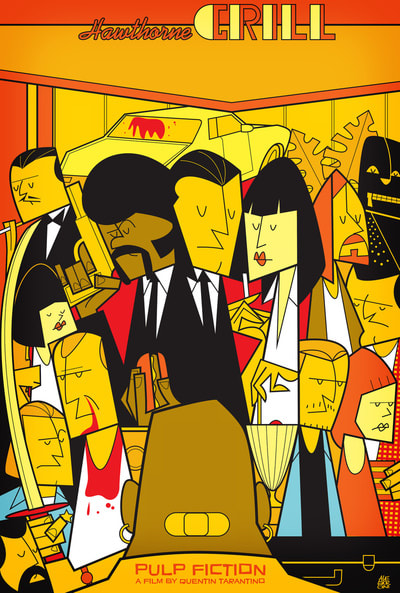
The Making of Pulp Fiction: Quentin Tarantino’s and the Cast’s Retelling

When Pulp Fiction thundered into theatres a year later, Stanley Crouch in the Los Angeles Times called it a high point in a low age. Time declared, It hits you like a shot of adrenaline straight to the heart. In Entertainment Weekly, Owen Gleiberman said it was nothing less than the reinvention of mainstream American cinema.

Made for $8.5 million, it earned $214 million worldwide, making it the top-grossing independent film at the time. Roger Ebert called it the most influential movie of the 1990s, so well-written in a scruffy, fanzine way that you want to rub noses in it—the noses of those zombie writers who take ‘screenwriting’ classes that teach them the formulas for ‘hit films’.

Pulp Fiction resuscitated the career of John Travolta, made stars of Samuel L Jackson and Uma Thurman, gave Bruce Willis new muscle at the box office, and turned Harvey and Bob Weinstein, of Miramax, into giants of independent cinema. Harvey calls it the first independent movie that broke all the rules. It set a new dial on the movie clock.

It must be hard to believe that Mr Tarantino, a mostly self-taught, mostly untested talent who spent his formative years working in a video store, has come up with a work of such depth, wit and blazing originality that it places him in the front ranks of American filmmakers, wrote Janet Maslin in The New York Times. You don’t merely enter a theatre to see Pulp Fiction: you go down a rabbit hole. Jon Ronson, critic for The Independent, in England, proclaimed, Not since the advent of Citizen Kane … has one man appeared from relative obscurity to redefine the art of movie-making — via redwolf.newsvine.com

Where Men See White, Women See Ecru

If you’ve ever found yourself at a paint store with a member of the opposite sex trying to decide between, say, laguna blue and blue macaw, chances are you’ve disagreed over which hue is lighter or looks more turquoise.

Take comfort in the fact that the real blame lies with physiology: Neuroscientists have discovered that women are better at distinguishing among subtle distinctions in color, while men appear more sensitive to objects moving across their field of vision — via redwolf.newsvine.com