Extinct reptile named for lizard king Jim Morrison

An extinct plant-eating reptile that roamed the steamy forests of South-east Asia some 40 million years ago has been named for Doors front man Jim Morrison.

Jason Head, a palaeontologist at the University of Nebraska-Lincoln and his colleagues describe the reptile — named Barbaturex morrisoni — this week in the scientific journal Proceedings of the Royal Society B. It  lived in the strange days when the Earth’s poles were ice-free and atmospheric carbon dioxide levels were nearly twice what they are today, and, at six feet long and upwards of 60 pounds, it was one of the largest known lizards ever to walk on land.

B morrisoni’s remains had been waiting for the sun a long time. The giant lizard’s remains were unearthed in Myanmar — a country located between the Horse Latitudes — in the 1970s, but they languished at the University of California Museum of Palaeontology until a few years ago, when Head and his team began examining them — via redwolf.newsvine.com

Immune training MS trial safe

An experimental treatment to stop the body attacking its own nervous system in patients with multiple sclerosis (MS) appears safe in trials.

The sheath around nerves cells, made of myelin, is destroyed in MS, leaving the nerves struggling to pass on messages.

A study on nine patients, reported in Science Translational Medicine, tried to train the immune system to cease its assault on myelin.

The MS Society said the idea had exciting potential.

As nerves lose their ability to talk to each other, the disease results in problems moving and balancing and can affect vision.

There are drugs that can reduce number and severity of attacks, but there is no cure — via redwolf.newsvine.com

Alexandro, South American Tapir / Artis Zoo

Alexandro, South American Tapir / Artis Zoo

When Ydra, a female South American Tapir at the Netherlands’ Artis Zoo, was restless and refused her food last week, zoo keepers knew it wouldn’t be long before she delivered her calf. Sure enough, on 10 April, a male calf was born and Ydra licked him clean as he lay beside her on the straw. Named Alexandro, the calf is the first offspring for Ydra and her mate Carlo — via ZooBorns

Australia’s de-facto Internet filter may block 250k sites

The Australian Securities and Investment Commission (ASIC), has told a hearing of the Australian Parliament’s Senate Estimates committee that its attempt to block access to the IP address of one investment scam site could have blocked 250,000 sites in total.

In its opening statement to the committee (Crikey has a copy here), ASIC said that in addition to the blocking of an IP address that took out 1,200 sites hosted at the same address, a similar request in March blocked 250,000 sites. In its defence, the commission said most of the URLs hosted at the target IP appear to contain no substantive content and that fewer than 1,000 active sites had been affected (El Reg presumes that the remaining 249,000 were parked domains) — via redwolf.newsvine.com

Cashout Service for Ransomware Scammers

There are 1,001 ways to swindle people online, but the hardest part for crooks is converting those ill-gotten gains into cash. A new service catering to purveyors of ransomware — malware that hijacks PCs until victims pay a ransom — levees a hefty fee for laundering funds from these scams, and it does so by abusing a legitimate Web site that allows betting on dog and horse races in the United States.

Ransomware is most often distributed via hacked or malicious sites that exploit browser vulnerabilities. Typically, these scams impersonate the Department of Homeland Security or the FBI (or the equivalent federal investigative authority in the victim’s country) and try to frighten people into paying fines to avoid prosecution for supposedly downloading child pornography and pirated content.

Ransomware locks the victim’s PC until he either pays the ransom or finds a way to remove the malware. Victims are instructed to pay the ransom by purchasing a prepaid MoneyPak card, sold at everything from Walgreens to Wal-Mart (some scams tell victims to pay using a PaySafe or Ukash card). Victims are then told to send the attackers a 14-digit voucher code that allows the bad guys to redeem those MoneyPak vouchers for cash.

Trouble is, taking funds off of a MoneyPak requires either spending it at stores that accept it, or hooking it up to a US bank account, to PayPal, or to a prepaid Visa or Mastercard. What’s more, most miscreants who are even halfway competent at spreading ransomware can expect to collect dozens of MoneyPak codes per day, so cashing out via the above-mentioned methods simply does not scale well for successful bad guys (particularly those who live outside of the United States) — via redwolf.newsvine.com

Australia, your lack of cyber transparency disturbs me

Australia’s security agencies are amongst the most secretive on the planet, far more so than their counterparts in the US and UK.

Why is this?

Four Corners journalist Andrew Fowler was told that it’s down to Australia’s junior relationship with its historical allies, the UK and then the US.

“We, the Australians, look after other people’s secrets, and so we have to prove we are more able to look after their secrets than anybody else … It’s a way of explaining in some way this rather, I suppose you could say, closed shop,” he told the BCC World Service program World Have Your Say (MP3).

Whether the explanation Fowler was given is true or not, this culture of extreme secrecy leads to an information vacuum.

Is China trying to hack Australian government agencies? Yes, of course. Everyone is hacking everyone else. That’s how espionage is done these days. But how successful were they? Who knows. Does the government have a valid case for more surveillance? Again, who knows.

Without hard facts, critics and supporters alike are free to assume the worst — either that incompetent security services are riddled with hacks while pursuing a massive power grab, or that Chinese hackers will bring the country to its knees unless we immediately lock down the internet and log everything. The truth is presumably somewhere in the middle, but without facts, a nuanced debate is impossible.

And without facts, we’re free to judge the government’s credibility by the hand-waving cyber language they use. I’ve already given my opinion on all this cybering and the cyberthreat beat-up, but things reached a new low this week with the coining of cybercrisis.

While the government continues to play secret squirrel, the infosec industry is getting into transparency — via redwolf.newsvine.com

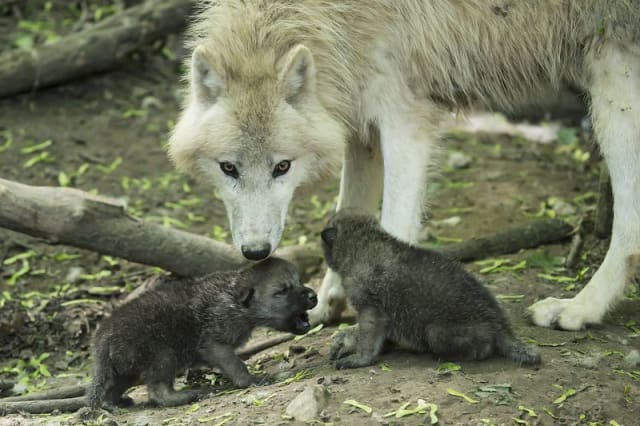
Red Wolf Pups / Jackson Zoo

Red Wolf Pups / Jackson Zoo

When an aggressive virus strikes, there’s often little that can be done. Fortunately,Jackson Zoo’s dedicated animal care team was able to give the medical attention needed to rescue a litter of Red Wolf pups from a virus that had been transmitted by the pups’ mother, Taladu — via ZooBorns

Japan Suspends Some Imports of US Wheat

Japan has suspended some imports of wheat from the United States after genetically engineered wheat was found on an Oregon farm.

The Agriculture Department announced the discovery on Wednesday. No genetically engineered wheat has been approved for American farming.

Japan is one of the largest export markets for American wheat growers. Katsuhiro Saka, a counsellor at the Japanese Embassy in Washington, said Thursday that Japan had cancelled orders of western white wheat from the Pacific Northwest and also of some feed-grade wheat.

In most countries the unapproved genetically modified wheat would be a target of concern, Mr Saka said. The Japanese people have similar kinds of concerns.

In addition, the European Union said it would test incoming American shipments and block any containing genetically modified wheat — via redwolf.newsvine.com

Ape-like feet found in study of museum visitors

Scientists have discovered that about one in thirteen people have flexible ape-like feet.

A team studied the feet of 398 visitors to the Boston Museum of Science.

The results show differences in foot bone structure similar to those seen in fossils of a member of the human lineage from two million years ago.

It is hoped the research, published in the American Journal of Physical Anthropology, will establish how that creature moved.

Apes like the chimpanzee spend a lot of their time in trees, so their flexible feet are essential to grip branches and allow them to move around quickly — but how most of us ended up with more rigid feet remains unclear.

Jeremy DeSilva from Boston University and a colleague asked the museum visitors to walk barefoot and observed how they walked by using a mechanised carpet that was able to analyse several components of the foot — via redwolf.newsvine.com