In the chaos of the days leading up to the actual destruction of the wall and the fall of East Germany’s communist government, frantic Stasi agents sent trucks full of documents to the Papierwolfs and Reisswolfs — literally paper-wolves
and rip-wolves
, German for shredders. As pressure mounted, agents turned to office shredders, and when the motors burned out, they started tearing pages by hand — 45 million of them, ripped into approximately 600 million scraps of paper. The machine-shredded stuff is confetti, largely unrecoverable. But in May 2007, a team of German computer scientists in Berlin announced that after four years of work, they had completed a system to digitally tape together the torn fragments. Engineers hope their software and scanners can do the job in less than five years
The Australian Attorney-General’s department is inviting submissions from the public on copying of movies and images in different formats for private use. These were sections of the Copyright Amendment Act introduced in December 2006 that made it legal for Australians to do things they’d been doing for decades, such as recording a tv broadcast to tape or disc, but illegal to watch such recordings more than once. The Minister is required by the Act to review these exceptions after two years — via Boing Boing
After two months of downtime, it is still uncertain whether Demonoid will ever return. However, if it is up to The Pirate Bay, it will. The Pirate Bay has recently offered 2 servers to the Demonoid team, in Sweden of course
Last week, seven Swedish MPs wrote to a prominent Swedish tabloid newspaper Expressen
to express their dissatisfaction with proposals for dealing with copyright infringers. Now, that number has increased to 13, and the issue seems to keep growing
The agency that governs educational technology in the United Kingdom has advised schools in the country to keep Microsoft’s Windows Vista operating system and its Office 2007 software out of the classroom and administrative offices. Becta officials said a study the group commissioned found that upgrading school systems from Windows XP to Vista and Office 2007 would increase costs and create software compatibility problems while providing little benefit
The expected price reconciliation between the iTunes UK store and the other European stores is officially in the works. Interesting to note that Apple is throwing down the gauntlet with the labels on UK vs Eurozone wholesale music pricing, so that we might see some subtractions from the UK store if the labels don’t jump in line
Russia’s top-level domain — with the ASCII suffix .ru — translates into Cyrillic as .py, the domain name of Paraguay. That could pose security problems for Russian users. Kim Davies, who controls the domain names at the international domain naming agency Icann told the Guardian: Russia has a second top level domain name of .ru in ASCII code, but is pushing for .rf in Cyrillic.
The internationalised domain name gives them an opportunity to do things which are now being tested in China, where they are currently using Chinese characters for three top-level domains: .net, .com and .cn
HECToR, the largest supercomputer in the UK, is around five times more powerful than its predecessor, HPCx, which is also at the University of Edinburgh. It measures up well internationally, sitting at 17 in the top500.org list of the most powerful computers in the world
The WTO’s recent ruling on Antigua’s complaint against the US over the banning of online gambling resulted in a payment to the island nation much less than they asked for. It appears, though, that this payment was just part of the WTO’s compensation package for Antigua/Barbuda. Via Kotaku, the Hollywood Reporter notes that the Caribbean country can now freely ignore US copyright laws — legally. This dispensation is apparently limited to some $21 million a year — via Slashdot
From 20 January 2008 new content laws introduced by the Federal Government will force sites to verify the age of users before accessing content intended for mature audiences. The laws bring internet classification into line with Film and Book classification laws and completely prohibits X18+ and RC content from the internet. ACMA (The Australian Communications and Media Authority) claims that adults will not be affected by the new laws, yet user-generated and even chatrooms are required to be assessed for classification and powers are granted to ACMA to send take down
notices to offending sites — via Slashdot
Researchers in a remote Indonesian jungle have discovered a giant rat that is about five times the size of a typical city rat and a tiny possum
So, I decided to take the RFID passport out for a spin, and now Neibi and I are in Sapporo, Japan, sequestered in a business hotel opposite Hokkaido University. Outside it’s a bracing -6 degrees celsius.
I will now relate to you the tale of day one.
On the first day, December 14th, we flew from Sydney to Narita (Tokyo international airport). We flew JAL and it was pretty good: the flight left late yet arrived early, we got vegetarian food, and the headrest entertainment screens were absorbing. The chick who checked us in was like an angrier Lee Lin Chin, but she got the job done.
I spent my eight and a half hours playing go (on the headrest: victory by resignation), watching movies (Stardust, enjoyable; and Ratatouille, a competent entry), playing Travel Blokus (with Neibi… we tried to play Ingenious Travel Edition but she dropped the pegs), reading Nabokov (short stories), eating (rice crackers), and playing shogi (on the headrest: defeat by checkmate).
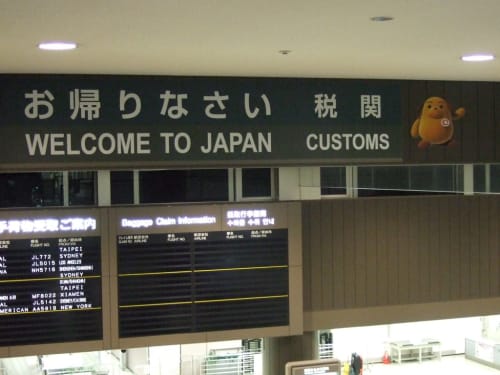
When we landed we got into a tiny train (my head touched the roof) which took us to honour systems customs (“I’d like to declare…” “No, just go through.”). From there we took the famous airport limo bus to Haneda (Tokyo domestic).
So, the first day was most spent sitting down, but after checking into our hotel (which was nice) we strolled through the industrial ghetto seeking dinner. We found an extremely Japanese street, which was laid out as follows: curry house, medical clinic, hana-ya, yakitori stand, level crossing, McDonalds, Lawson konbini, karaoke bar, soba restaurant. The soba place had a kana / primary school kanji menu so I thought I had a decent shot at ordering our dinner.
We got ooki yasai soba o futatsu, which for some reason had spam in it (“spam, spam, eggs and spam, tenpura and spam”, etc). The patrons mocked us in a friendly fashion. “Dozo”, they said, gesturing to the counter as I fell over trying to remove my shoes. The proprietor was a fan of Australia and kept mentioning Kingusu Kurossu, which he was keen on.
The next morning we ate breakfast at the hotel (an East-West buffet with fruit salad and cold miso), then flew to Sapporo, Hokkaido.
A screen shot posted to the web over the weekend seems to show that Canada’s largest provider of high-speed internet access is exploring a controversial data substitution technique that lets it add its own content to the web pages customers visit. Expect this development to become Exhibit A in the case for net neutrality legislation. Lauren Weinstein, a technology consultant in Los Angeles and a long-time Internet activist, posted a screen-shot of a Rogers-modified Google search page this past Saturday on his blog. Rogers vice president of communications Taanta Gupta confirmed that Rogers is experimenting with this technique as a way to communicate with its customers
Rupert Murdoch-owned British ISP Sky is migrating their customers to the Google Apps platform, and the customer experience is terrible. Their 1 million customers were told that they need to change their client settings to enable SMTP Authentication and other settings on a certain date — but not to do it before then or their e-mail would break; but if you don’t do it on the date your e-mail will also break. Oh, and if you’re a POP user you also need to enable that manually in the Skoogle
interface, as seemingly they chose not to run a system-wide command to allow it for all users. In addition, if you want help then you’re pretty much on your own. One user has made seven support calls and still not been able to access his e-mail since the migration. Hardly surprising that the story has made the papers with their help-desk in meltdown — via Slashdot
Five Australian-based journalists were deliberately killed by Indonesian troops in East Timor in 1975, an Australian coroner’s court has ruled. Dorelle Pinch, deputy coroner of New South Wales, said the killings could constitute a war crime. The two Australians, two Britons and a New Zealander, known as the Balibo Five, were killed to stop them exposing the invasion of East Timor
For the first time in more than 60 years a Colossus computer is cracking codes at Bletchley Park. The machine is being put through its paces to mark the end of a project to rebuild the pioneering computer. It is being used to crack messages enciphered using the same system employed by the German high command during World War II. The Colossus is pitted against modern PC technology which will also try to read the scrambled messages
The Kremlin is using Russia’s new anti-software-piracy laws to target dissident media outlets and shut them down. This is an eerie echo of the Soviet era, when black marketeering and other universal activities were used as the excuse for arresting dissidents and other inconvenient people. The difference is that this time, the anti-piracy laws were enacted at the behest of the US trade representative, who made stringent patent and copyright enforcement a condition of the recent US-Russia free trade agreement, forcing Russia to take on board stricter laws than those in place in the US. This includes laws that would never pass Constitutional muster stateside, like a scheme for police licensing and inspection of CD and DVD presses — via Boing Boing
Google is undergoing an investigation by the European Union for its $3.1 billion acquisition of internet advertiser DoubleClick. The United States’ Federal Trade Commission has been reviewing the acquisition since May
One NATO figure said the effect was as big a shock as the Russians launching Sputnik
. American military chiefs have been left dumbstruck by an undetected Chinese submarine popping up at the heart of a recent Pacific exercise and close to the vast USS Kitty Hawk. By the time it surfaced, the 160ft Song Class diesel-electric attack submarine had sailed within viable range for launching torpedoes or missiles at the carrier. The incident caused consternation in the US Navy, which had no idea China’s fast-growing submarine fleet had reached such a level of sophistication — via Slashdot
The shadowy hacker and malware hosting network that only recently fled Russia to set up operations in China has now pulled the plug there and vanished yet again. An analyst at VeriSign’s iDefense Labs unit said iDefense had tracked RBN’s migration earlier in the week from servers based in Russia to ones running in China, after obtaining at least seven net blocks of Chinese IP addresses. As of Wednesday, RBN controlled 5,120 IP addresses assigned to Chinese service providers; known RBN clients were even seen using those addresses that day. But with its China move putting the spotlights of the media and the security community on the organization, RBN suddenly went offline on Thursday. They severed connections to six of the seven net blocks on November 8,
the analyst said. RBN as a single organisation may be dead and gone; it may even now be breaking up into smaller pieces farmed out to multiple countries’ Internet infrastructures — via Slashdot


 RSS – Posts