Lindows, the company that provides a Linux OS for the desktop, has changed its name to Lin—s — pronounced Lindash
— in compliance with court orders in Sweden, Belgium, the Netherlands and Luxembourg
The federal Government has moved to give greater powers to spy agencies to intercept people’s e-mails. The Telecommunications (Interception) Amendment Bill 2004 also allows warrants to be sought in connection with the investigation of a wider range of serious offences, including terrorism. The bill, if passed by parliament, will allow recording of calls to ASIO public lines
Teresa Nielsen Hayden has a great breakdown of why author manuscripts are rejected:
- Author is functionally illiterate.
- Author has submitted some variety of literature we don’t publish: poetry, religious revelation, political rant, illustrated fanfic, etc.
- Author has a serious neurochemical disorder, puts all important words into capital letters, and would type out to the margins if MSWord would let him.
- Author is on bad terms with the Muse of Language. Parts of speech are not what they should be. Confusion-of-motion problems inadvertently generate hideous images. Words are supplanted by their similar-sounding cousins: towed the line, deep-seeded, incentiary, reeking havoc, nearly penultimate, dire straights, viscous/vicious.
- Author can write basic sentences, but not string them together in any way that adds up to paragraphs.
- Author has a moderate neurochemical disorder and can’t tell when he or she has changed the subject. This greatly facilitates composition, but is hard on comprehension.
- Author can write passable paragraphs, and has a sufficiently functional plot that readers would notice if you shuffled the chapters into a different order. However, the story and the manner of its telling are alike hackneyed, dull, and pointless.
(At this point, you have eliminated 60-75% of your submissions. Almost all the reading-and-thinking time will be spent on the remaining fraction.)
- It’s nice that the author is working on his/her problems, but the process would be better served by seeing a shrink than by writing novels.
- Nobody but the author is ever going to care about this dull, flaccid, underperforming book.
- The book has an engaging plot. Trouble is, it’s not the author’s, and everybody’s already seen that movie/read that book/collected that comic.
(You have now eliminated 95-99% of the submissions.)
- Someone could publish this book, but we don’t see why it should be us.
- Author is talented, but has written the wrong book.
- It’s a good book, but the house isn’t going to get behind it, so if you buy it, it’ll just get lost in the shuffle.
- Buy this book.
There’s also a nice stab taken at the whiny authors who submit their rejection notices to RejectionCollection.com.
Perl, a high-level programming language that was critical in the initial construction of the Internet, is undergoing major renovations from author Larry Wall with the help of the Perl development community. The general release is about 18 months away. Although Wall still is designing Perl 6, there is a good sense of what it will include. One thing is certain: Perl 6 will look vastly different from its predecessor
A University of Pennsylvania researcher seeking ways to treat illness said studies in rats show muscle mass, strength and endurance can be increased by injections of a gene-manipulated virus that goes to muscle tissue and causes a rapid growth of cells, raising concerns that the virtually undetectable technology could be used illegally to build super athletes. None of which will bother Angle-grinder Man and his other non-powered superhero mates as they go about their daily crime fighting duties
The music industry considers Michele Scimeca a pirate. The Morris County mom has her own term for record executives: Racketeers. In what legal experts described as a novel strategy, Scimeca is citing federal racketeering laws like the one that jailed mob boss John Gotti to counter-sue record labels that accused her in December of sharing some 1,400 copyrighted songs over the Internet
What do Gandalf and Magneto have in common? Both are played by Sir Ian McKellen. Both are figures of literature, one being a novel, the other being a comic book. And both have porn written about them. Slash fiction is a genre of stories written by fans about science fiction/fantasy characters in erotic situations. We know this because McKellen brought it up.
McKellen is like your dirty old grandpa, if your dirty old grandpa was British. He’ll make totally unexpected comments about pornography and sexuality.
The Brightmail Reputation Service, monitors hundreds of thousands of e-mail sources to determine how much mail sent from these addresses is legitimate and how much is spam. The company gathers information from user reports and from its Probe Network — a collection of decoy e-mail in-boxes designed to catch spam — to determine whether a given IP address sends valid or junk messages. The service creates a profile of each e-mail source from which administrators can decide whether to block mail from these sources or allow it into the company. Brightmail also will make available a safe list
of e-mail addresses that have never sent spam to users of the Reputation Service free of charge
HMS Beagle, the ship Darwin travelled on during his famous voyage, may have been found. Marine archaeologists believe they have found the ship, which has been resting at the bottom of some Essex marshes for the last century
The Australian Communications Authority has introduced a new method of penalising telecommunications companies that breach the law, in a move designed to reduce the number of court cases
Advertising writers in Florida were planning to pitch haemorrhoid-relief products with a commercial featuring the Johnny Cash classic Ring of Fire, but Cash’s family said there’s no way they will let it happen
Librarians have warned that the free trade deal will lead to huge increases in copyright licence fees paid by Australians for use of intellectual property, including novels, poems, films and songs. And a legal expert said it was literally a Mickey Mouse
deal, as the Disney Corporation had been among its most powerful backers. The 20-year extension of copyright terms brings Australia into line with US restrictions — via Lessig Blog
Researchers were surprised to discover that M&Ms randomly dumped into a bowl pack together much more densely than spheres. Why? Asymmetric ellipsoids like M&Ms can touch eleven neighbours when dumped together while spheres only saddle up to six. Understanding how particles pack together can help scientists develop new and denser materials, like ceramics for heat shields
Telstra has announced its new budget prices for ADSL, beating out the fledgling Optus residential DSL service a day before its launch. The price cuts encompass the telecommunications heavyweight’s DSL and cable modem broadband offerings. Telstra said it would begin charging BigPond customers $29.95 a month for entry-level high-speed ADSL and cable products — the same price as some dial-up offerings — undercutting Optus’s cheapest DSL service price by $20
I’ve seen walk-throughs and screen-movies of video games that explain how to win, but this takes the cake. It’s a how to win guide for Super Mario Brothers, and the authors have invented an ingenious, ASCII-based tablature for noting the proper key presses at each moment in the game for a perfect win. It’s hard to say what’s more impressive here: the obsessive documenting of the winning strategy or the marvelous creativity in the invention of the tablature itself
Dan Geer lost his job, but gained his audience. The very idea that got the computer security expert fired has sparked serious debate in information technology. The idea, borrowed from biology, is that Microsoft has nurtured a software monoculture
that threatens global computer security. Geer and others believe Microsoft’s software is so dangerously pervasive that a virus capable of exploiting even a single flaw in its operating systems could wreak havoc
Teachers in a German school were treated in hospital after gobbling up an anonymously donated chocolate cake, unaware it was laced with hashish
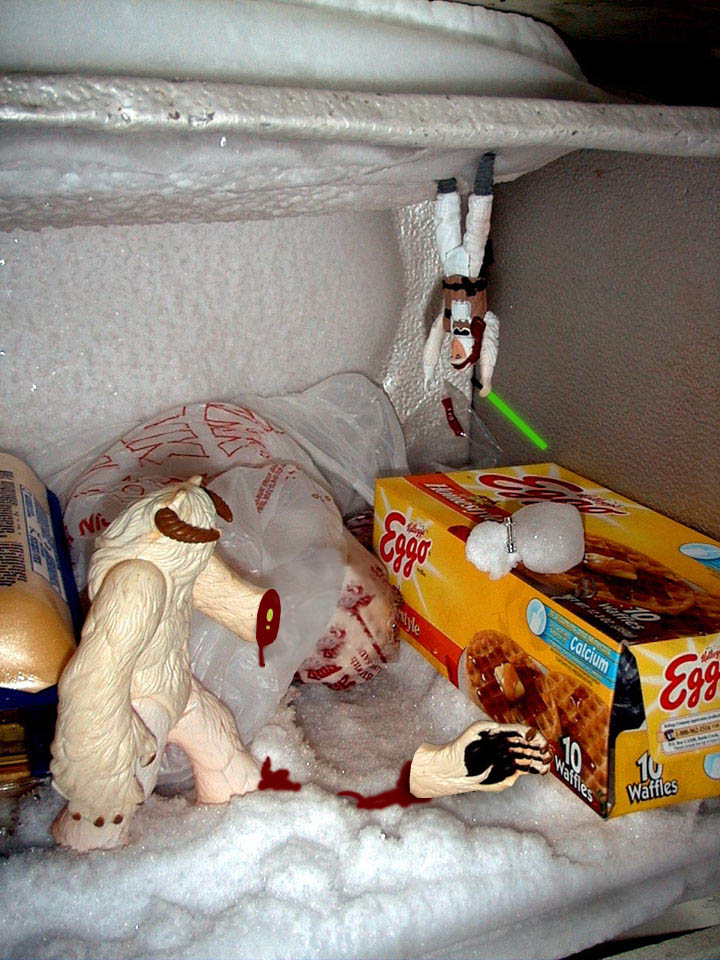
Some wag has found a use for an iced up freezer, recreating scenes from Star Wars.
Strange, I only ever find peas and paddle pop sticks embedded in my freezer, which makes cleaning it out a bit like a mini archaeological dig. Maybe I should be on the lookout for small plastic men setting up camp in there in the future.
Australian Paul Cochrane mods expired Mazda rotary engines into fish tanks for a very reasonable price
Google has banned the ads of environmental group Oceana protesting Royal Caribbean’s sewage treatment methods, casting a spotlight on the editorial policies that control the popular web site’s lucrative marketing program


 RSS – Posts