History, Politics, World

9 questions about Syria you were too embarrassed to ask

The United States and allies are preparing for a possibly imminent series of limited military strikes against Syria, the first direct US intervention in the two-year civil war, in retaliation for President Bashar al-Assad’s suspected use of chemical weapons against civilians.

If you found the above sentence kind of confusing, or aren’t exactly sure why Syria is fighting a civil war, or even where Syria is located, then this is the article for you. What’s happening in Syria is really important, but it can also be confusing and difficult to follow even for those of us glued to it.

Here, then, are the most basic answers to your most basic questions. First, a disclaimer: Syria and its history are really complicated; this is not an exhaustive or definitive account of that entire story, just some background, written so that anyone can understand it — via redwolf.newsvine.com

Business, Technology

Microsoft to buy Nokia’s devices, services unit for $7.2B

Microsoft announced on Monday it will acquire Nokia’s devices and services unit in a bid to accelerate the software giant’s Windows ecosystem.

The deal is set to go ahead for about $5 billion (€3.79bn), with an additional $2.17 billion (€1.65bn) to be spent on licensing Nokia’s patents.

Boards of both companies agreed the transaction, which will see the Redmond, Wash.-based software giant purchase the Espoo, Finland-based company’s phone making unit, patents, and license and use its mapping services — via redwolf.newsvine.com

Wildlife

Bad Dog, Good Dog / Pedigree

For rescue dogs like Mojo, the right nutrition is the first step to a Brighter Future.

This year we at Pedigree are aiming to feed as many Brighter Futures as possible, which is why we are promising to donate One Million Meals to rescue dogs nationwide as part of our Pedigree Feeding Project — via Youtube

Technology

A Data Broker Offers a Peek Behind the Curtain

It can be disconcerting to learn what, not to mention how much, marketers know about us. Consider a consumer like Scott E Howe.

The Acxiom Corporation, a marketing technology company that has amassed details on the household make-up, financial means, shopping preferences and leisure pursuits of a majority of adults in the United States, knows that Mr Howe is 45, married with children, the owner of a house in the 2,500-square-foot range, and is interested, among other things, in tennis, domestic travel, cooking, crafts, sweepstakes and contests. Those intimate details, Mr Howe says, are entirely accurate.

I am crazy about that stuff, he says of the sweepstakes and contests.

Mr Howe is one of the first Americans to get a detailed glimpse of his own marketing profile because he happens to be the chief executive of Acxiom. But most consumers never learn the specific pieces of information that have been compiled about them by marketers.

That is about to change. Acxiom, one of the most secretive and prolific collectors of consumer information, is embarking on a novel public relations strategy: openness. On Wednesday, it plans to unveil a free Web site where United States consumers can view some of the information the company has collected about them, just as Mr Howe did.

The data on the site, called AbouttheData.com, includes biographical facts, like education level, marital status and number of children in a household; homeownership status, including mortgage amount and property size; vehicle details, like the make, model and year; and economic data, like whether a household member is an active investor with a portfolio greater than $150,000. Also available will be the consumer’s recent purchase categories, like plus-size clothing or sports products; and household interests like golf, dogs, text-messaging, cholesterol-related products or charities.

Each entry comes with an icon that visitors can click to learn about the sources behind the data — whether self-reported consumer surveys, warranty registrations or public records like voter files. The program also lets people correct or suppress individual data elements, or to opt out entirely of having Acxiom collect and store marketing data about them — via redwolf.newsvine.com

Wildlife

Snow Leopard Cub / Brookfield Zoo

The Brookfield Zoo is proud to share the birth of a male Snow Leopard cub, born on 13 June. The cub was born to first time mum Sarani and her mate, Sabu. At just over two months, the cub weighs about 10 pounds. The cub will remain off exhibit until he is about 3 months old. This will allow him time to bond with mum before making his public debut in mid-September — via ZooBorns

Steampunk Computer / steamworker

Steampunk Computer / steamworker

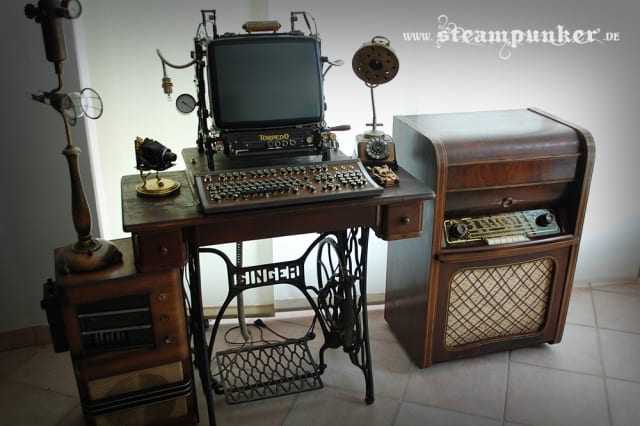
Fully working Steampunk workstation consisting of a computer table, a computer, a monitor, a wireless keyboard and a wireless mouse. The table was build from an old Singer sewing machine. The wood was completely reapplied (the patina retained). Three compartments provide storage space for small items. The PC was installed in an old wooden radio cabinet — via deviantART

Iconic Case Study Houses Finally Reside on National Register

At long last the Los Angeles Conservancy‘s effort to get a set of homes in the region included on the National Register of Historic Places has paid off, with the announcement that 11 of the Case Study Homes are deemed historically significant.

Ten of the homes have been placed on the list, according to the Conservancy. The 11th home did not get put on the list despite eligibility because of owner objection. All of them will enjoy equal preservation protections under the California Environmental Quality Act (CEQA), says the Conservancy.

The Case Study program grew out of a post-WWII discussion of the future of architecture as a new era of building dawned. The idea was to create affordable, well-designed Mid-Century Modern homes for American families (of course, putting many in fancy neighbourhoods ensured the average Angeleno wasn’t likely to ever call one home, alas).

Not all the planned homes were built, and the program didn’t spring forth a gush of mass-produced affordable houses from the prototypes, but it did give architecture wonks and admirers much to love over the years. Most iconic is probably Case Study House #22, the Stahl house, designed by Pierre Koenig, which is oft-photographed — via redwolf.newsvine.com

Parallels Access recreates Windows and Mac software as tablet apps for the iPad

Parallels has released an app that allows Windows and Mac OS X software to be used on the iPad.

Parallels Access customises the way apps are launched and how they respond to make them better suited to a touchscreen device.

Mac and Windows apps are run through a launcher, which presents each one as a large touchscreen icon. The launcher is automatically populated but apps can be added or removed.

Apps launch in full screen, with Access adding support for touchscreen taps and swipes, and a magnifying glass. When a user fails to tap squarely on a screen button, the app makes a best guess at the most likely intended action, making it easier to use touch with tiny buttons and other UI features designed for a mouse pointer.

Users can switch between running apps by tapping to bring up a quick bar.

Words and graphics can also be copied from within apps and pasted to other iPad apps or between Mac and Windows apps, using iPad-native select and drag copying.

Access works by streaming applications from a Mac or Windows PC over a network to the iPad. The machine can’t be used while the connection is active. Parallels Access can operate on both 3G and wi-fi networks but Parallels recommends using a broadband wi-fi network for a more stable connection — via redwolf.newsvine.com

New Zealand bans software patents

New Zealand has finally passed a new Patents Bill that will effectively outlaw software patents after five years of debate, delay and intense lobbying from multinational software vendors.

Aptly-named Commerce Minister Craig Foss welcomed the modernisation of patents law, saying it marked a significant step towards driving innovation in New Zealand.

By clarifying the definition of what can be patented, we are giving New Zealand businesses more flexibility to adapt and improve existing inventions, while continuing to protect genuine innovations, Foss said.

The nearly unanimous passage of the Bill was also greeted by Institute of IT Professionals (IITP) chief executive Paul Matthews, who congratulated Foss for listening to the IT industry and ensuring software patents were excluded — via redwolf.newsvine.com