Former primary school teacher David Kramer jailed for sexually assaulting students at Yeshiva College

A former teacher at a Jewish primary school in Melbourne has been sentenced to three years and four months in jail for sexually assaulting four students.

David Kramer, 52, pleaded guilty to five charges of indecent assault and one of an indecent act with a child under 16.

The offences were committed against four boys aged between 10 and 11 at the Yeshivah College in St Kilda East between 1989 and 1992 — via redwolf.newsvine.com

Google Reader replacement Old Reader crashes

The Darwinian derby to determine which RSS-reading service would replace Google Reader as the world’s dominant feed-wrangler may just have produced its first extinction event, after theoldreader.com choked on its recently-enlarged database and crashed.

The Old Reader’s schtick is that it looks and behaves pretty much exactly like Google Reader, which made it a nice alternative for refugees.

As the graphs below (taken from the service’s blog) show, user numbers have surged from around 10,000 in March to over 375,000 today.

Google Reader replacement Old Reader crashes

That 5 July post also says the outfit uses … this amazingly cheap but somewhat unreliable hosting provider that has led to some issues with our database servers and outages.

Old Reader seems to have decided to do something about that, but the something has failed — via redwolf.newsvine.com

Belarus internet infested with spammers

Almost 30% of all net addresses in Belarus are blocked by anti-spam firms because of the amount of junk mail passing through them, says a report.

East European nations top the list of countries with the largest percentage of blacklisted net addresses, said security firm Cloudmark.

It said Belarus had become popular among spammers as other nations cracked down on junk-mail senders.

The US was still the single biggest source of spam, it said,

Belarus (27.4%), Romania (22.3%) and Russia (3%) filled the top three slots of a list of nations that have IP addresses known to be sources of spam, said Cloudmark researcher Andrew Conway.

Now, he said, data traffic from just over three million Belarusian IP addresses was being blocked in an attempt to stem the flood of junk mail passing through them — via redwolf.newsvine.com

Voting for Kevin Rudd makes me sick, but here’s why I’ll do it anyway

On the weekend, I shivered in the rain with a thousand other Melbournians to protest Kevin Rudd’s new plan to dump refugees boat-bound for Australia onto Papua New Guinea.

Papua New Guinea is still struggling to fight the consequences of colonialism; corruption and poverty have created conditions in which minorities have to face ongoing violence and hardship; its own government is struggling to prosecute people who torture women for witchcraft. The Australian government’s own travel advisory website cautions Australians that sexual assaults, including gang rapes targeting foreigners, can occur.

And so on election day, I shall be one of many who have Rudd’s moral betrayal in mind while their hand prepares to stab a first preference indication on their ballot paper. In my case, that 1 will be for the Greens — a vote executed, this time, with slightly more force than that with which Van Helsing stakes Dracula in a Hammer Horror movie.

Bizarrely, the Greens refugee policies are currently the most traditionally conservative of those on offer from the major parties in this election. They demand Australia simply accord to the UN refugee convention this country signed in 1951; to end offshore processing, meet humanitarian obligations and provide sanctuary to those fleeing persecution. Their policies seek to obey the rule of international law, and are founded on notions of family integrity and community inclusion.

Alternatively, the Rudd government’s radical, sudden, forced resettlement of vulnerable people has made me so angry I shall additionally preference the Australian Magical Moonbeam party, The Coalition for People Who Look Like Cats or the Australians For Putting Melons in Their Pants party — if their refugee policies are at all critical of Labor’s own. Such are both the promptings of my conscience, and the moral luxury of preferential voting.

But the curse of any voting system is that no matter who you vote for, someone has to get elected. And voting Greens hoping that their leader Christine Milne will be prime minister is comparable to convincing yourself that you’ve meaningfully moved on from a terrible high-school boyfriend because you’ve scribbled I HEART JUSTIN TIMBERLAKE!!! onto your maths textbook — via redwolf.newsvine.com

Faster Than the Speed of Light?

Harold G White, a physicist and advanced propulsion engineer at NASA, beckoned toward a table full of equipment there on a recent afternoon: a laser, a camera, some small mirrors, a ring made of ceramic capacitors and a few other objects.

He and other NASA engineers have been designing and redesigning these instruments, with the goal of using them to slightly warp the trajectory of a photon, changing the distance it travels in a certain area, and then observing the change with a device called an interferometer. So sensitive is their measuring equipment that it was picking up myriad earthly vibrations, including people walking nearby. So they recently moved into this lab, which floats atop a system of underground pneumatic piers, freeing it from seismic disturbances.

The team is trying to determine whether faster-than-light travel — warp drive — might someday be possibles — via redwolf.newsvine.com

Calls widen for GCSB law probe

The Privacy Commission has joined calls for further investigation into proposed new spying powers.

Commissioner Marie Shroff says the Law Commission should be asked to examine legislation and oversight of intelligence agencies.

The Government is proposing the Government Communications Security Bureau Amendment Bill to make it legal for the agency to spy on New Zealanders on behalf of other law enforcement bodies.

It says it is necessary to clarify the law after the GCSB was found to be illegally intercepting communications.

But the bill has met opposition, including from the Law Society and the Human Rights Commission — via redwolf.newsvine.com

New Zealand Government About To Legalise Spying On NZ Citizens

After admitting they have illegally spied on NZ citizens or residents 88 times (PDF) since 2003, the government, in a stunning example of arse covering, is about to grant the GCSB the right to intercept the communications of New Zealanders in its role as the national cyber security agency, rather than examine the role the GCSB should play and then look at the laws. There has been strong criticism from many avenues. The bill is being opposed by Labour and the Greens, but it looks like National now have the numbers to get this passed. Of course, the front page story is all about the royal baby, with this huge erosion of privacy relegated to a small article near the bottom of the front page. Three cheers, the monarchy is secure, never mind the rights of the people. More bread and circuses anyone? — via Slashdot

Five Baby Red Squirrels / Zoo am Meer Bremerhaven

Five Baby Red Squirrels / Zoo am Meer Bremerhaven

Germany’s Zoo am Meer Bremerhaven announced the arrival of its first Siberian Red Squirrel offspring. The five healthy youngsters were born seven weeks ago and are now old enough to begin exploring their habitat. This Siberian subspecies (Sciurus vulgaris exalbidus) is rarely kept in European zoos, so getting a chance to see these rambunctious and playful little red babies is a treat for zoo visitors — via ZooBorns

Embryonic stem cells could help restore sight to blind

Scientists have shown that light-sensitive retinal cells, grown in the lab from stem cells, can successfully integrate into the eye when implanted into blind mice. The technique opens up the possibility that a similar treatment could help people who have become blind through damage to their retinas to regain some of their sight.

Loss of light-sensitive nerve cells, known as photoreceptors, is a major cause of blindness in conditions such as age-related macular degeneration, retinitis pigmentosa and diabetes-related blindness. These conditions affect many thousands of people in the UK alone and there is no effective treatment at present. Scientists have been exploring the possibility of somehow replacing the photoreceptors, which come in two types: rods that help us see in low light conditions, and cones, which help us differentiate colours.

Robin Ali at University College London’s Institute of Ophthalmology and Moorfields Eye Hospital has previously shown that transplanting immature rod cells from the retinas of very young mice can restore vision in blind adult mice. It was a neat proof of concept, but the technique as it stood would be impractical as a way to treat people.

His latest work got around the problems of sourcing donor photoreceptor cells by growing and differentiating them from embryonic stem cells in a culture dish, rather than taking the cells from young mice. The donor photoreceptors developed normally once inside the adult mouse eyes and, crucially, formed nerve connections with the brain. The results are published on Sunday in the journal Nature Biotechnology — via redwolf.newsvine.com

Why David Cameron’s war on internet porn doesn’t make sense

The prime minister is looking at porn. For research purposes, of course. He’s not sitting in cabinet meetings peeking under the table at a looped three-second clip of a woman’s bra falling off that Michael Gove e-mailed to him by mistake. He is looking for a way he can pretend to be fighting it. He wants to declare himself the first prime minister to win the war on online porn. And, according to a letter leaked to the BBC last week, he reckons he has found one: default-on.

Default-on is a system whereby internet service providers block access to pornographic images as standard, unless the customer opts out of the filters. In the eyes of certain newspapers, it is the silver bullet solution to the problem of kids watching pornography. But, for various reasons, most of the major ISPs are not up for asking their customers: Do you want porn with that? They have negotiated with the government and agreed on a system called Active Choice + in which customers opt in for filters, rather than out for falling bras. The system gives new users a choice at installing filters, and existing customers the option of switching to safer browser modes. The default setting remains filter-free.

The leaked letter, sent to leading ISPs from the Department for Education, makes it clear that Cameron’s war or porn is propaganda masquerading as policy. It suggests: Without changing what you will be offering (ie active-choice +), the prime minister would like to be able to refer to your solutions [as] ‘default-on’. It is a sleight-of-hand worthy of the Ministry of Truth, a move from the “Let’s not and say we did!” school of regulation.

It raises the question: where else does Cameron use this line? Do his aides write to Starbucks, Google and Amazon to ask that, without changing what they are doing (avoiding paying billions in tax), they find a way for him to refer to this as “paying billions in tax”? Do they ask tobacco firms if, without ditching branded packaging, they could find a way for Dave to pretend they have? Has he ever asked George Osborne if he can refer to him as not George Osborne? — via redwolf.newsvine.com

Design, Wildlife

Dragon Gate / Harlech House

In Dublin, Ireland, stands an estate reminiscent of old folklore, complete with its own dragon! Of course, dragons are mythical creatures, so this home only has a dragon made of steel which acts as its gatekeeper. The property, known at Harlech House, was originally built in 1798 by a Welsh immigrant. (The estate is actually named after a town in Wales called Harlech and the national flag has a dragon on it.) Harlech House sits on less than an acre of land but is full of enchantment. It features religious iconography and fairy-tale motifs throughout the seven-bedroom home, but it’s the dragon gate that grabs the most attention — via My Modern Metropolis

Rise of the Warrior Cop

The police tactics at issue in the Stewart case are no anomaly. Since the 1960s, in response to a range of perceived threats, law-enforcement agencies across the US, at every level of government, have been blurring the line between police officer and soldier. Driven by martial rhetoric and the availability of military-style equipment — from bayonets and M-16 rifles to armoured personnel carriers — American police forces have often adopted a mind-set previously reserved for the battlefield. The war on drugs and, more recently, post-9/11 antiterrorism efforts have created a new figure on the US scene: the warrior cop—armed to the teeth, ready to deal harshly with targeted wrongdoers, and a growing threat to familiar American liberties.

The acronym SWAT stands for Special Weapons and Tactics. Such police units are trained in methods similar to those used by the special forces in the military. They learn to break into homes with battering rams and to use incendiary devices called flashbang grenades, which are designed to blind and deafen anyone nearby. Their usual aim is to clear a building — that is, to remove any threats and distractions (including pets) and to subdue the occupants as quickly as possible.

The country’s first official SWAT team started in the late 1960s in Los Angeles. By 1975, there were approximately 500 such units. Today, there are thousands. According to surveys conducted by the criminologist Peter Kraska of Eastern Kentucky University, just 13% of towns between 25,000 and 50,000 people had a SWAT team in 1983. By 2005, the figure was up to 80%.

The number of raids conducted by SWAT-like police units has grown accordingly. In the 1970s, there were just a few hundred a year; by the early 1980s, there were some 3,000 a year. In 2005 (the last year for which Dr Kraska collected data), there were approximately 50,000 raids.

A number of federal agencies also now have their own SWAT teams, including the Fish & Wildlife Service, NASA and the Department of the Interior. In 2011, the Department of Education’s SWAT team bungled a raid on a woman who was initially reported to be under investigation for not paying her student loans, though the agency later said she was suspected of defrauding the federal student loan program.

The details of the case aside, the story generated headlines because of the revelation that the Department of Education had such a unit. None of these federal departments has responded to my requests for information about why they consider such high-powered military-style teams necessary — via redwolf.newsvine.com

The Vitamin Myth: Why We Think We Need Supplements

On 10 October 2011, researchers from the University of Minnesota found that women who took supplemental multivitamins died at rates higher than those who didn’t. Two days later, researchers from the Cleveland Clinic found that men who took vitamin E had an increased risk of prostate cancer. It’s been a tough week for vitamins, said Carrie Gann of ABC News.

These findings weren’t new. Seven previous studies had already shown that vitamins increased the risk of cancer and heart disease and shortened lives. Still, in 2012, more than half of all Americans took some form of vitamin supplements. What few people realize, however, is that their fascination with vitamins can be traced back to one man. A man who was so spectacularly right that he won two Nobel Prizes and so spectacularly wrong that he was arguably the world’s greatest quack — via redwolf.newsvine.com

Enigma codebreaker Alan Turing to be given posthumous pardon

Alan Turing, the Enigma codebreaker who took his own life after being convicted of gross indecency under anti-homosexuality legislation, is to be given a posthumous pardon.

The government signalled on Friday that it is prepared to support a backbench bill that would pardon Turing, who died from cyanide poisoning at the age of 41 in 1954 after he was subjected to chemical castration.

Lord Ahmad of Wimbledon, a government whip, told peers that the government would table the third reading of the Alan Turing (statutory pardon) bill at the end of October if no amendments are made. If nobody tables an amendment to this bill, its supporters can be assured that it will have speedy passage to the House of Commons, Ahmad said.

The announcement marks a change of heart by the government, which declined last year to grant pardons to the 49,000 gay men, now dead, who were convicted under the 1885 Criminal Law Amendment Act. They include Oscar Wilde — via redwolf.newsvine.com

MIT Uses Machine Learning Algorithm To Make TCP Twice As Fast

MIT is claiming they can make the Internet faster if we let computers redesign TCP/IP instead of coding it by hand. They used machine learning to design a version of TCP that’s twice the speed and causes half the delay, even with modern bufferbloated networks. They also claim it’s more fair. The researchers have put up a lengthy FAQ and source code where they admit they don’t know why the system works, only that it goes faster than normal TCP — via Slashdot

747 Cowling Conference Table / MotoArt

Bring the iconic Boeing 747 into your conference room with MotoArt’s newest piece made from a General Electric engine nacelle. At 12′ wide this high-mirror polished table seats up to 12, and includes a set of 6 pop-up connection ports. The custom fabricated engine stator is set off with internal LED lighting in a color or your choice, and topped with a B-52 engine spinner.

Like the easily recognizable classic Jumbo Jets, Motoart’s Jumbo conference table is in a class by itself — via MotoArt

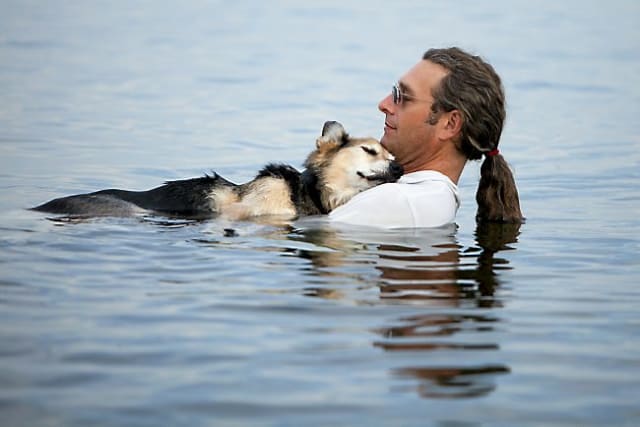
Schoep, the dog whose Internet photo touched millions, dies

Schoep + John Unger / Hannah Stonehouse Hudson

The world is mourning with a man who lost his dog Wednesday.

John Unger and his elderly dog, Schoep, became Internet celebrities last summer because of Bayfield, Wis., photographer Hannah Stonehouse Hudson’s photograph of the pair in the waters of Lake Superior. Unger took Schoep into the lake regularly to ease the discomfort of the dog’s arthritis.

People from Texas to Japan to Slovakia gave money to help pay Schoep’s veterinary bills, medications and laser treatments.

It gave the faithful companions another year together.

Schoep turned 20 on June 15. He died 26 days later. On Thursday, a photo of a paw print in the sand was posted on the Official Fan Page of Schoep and John on Facebook — via redwolf.newsvine.com