
Bill Tufts always wanted a pipe organ and had one installed in his home in Grand Rapids, Michigan. Tufts recently passed away, and the home is for sale, with the organ and its 2300 pipes. Don Haan of Haan Pipe Organ, who originally installed the organ, said the same job today would cost over a million dollars. Strangely, Tufts never learned to play the organ. The house is on the market for $129,000 — via Neatorama

The East German lieutenant colonel who gave the fateful order to throw open the Berlin Wall 25 years ago said he wept in silence a few moments later as hordes of euphoric East Germans swept past him into West Berlin to get their first taste of freedom.
Harald Jaeger said in an interview with Reuters that he spent hours before his history-changing decision trying in vain to get guidance from superiors on what to do about the 20,000 protesters at his border crossing clamouring to get out.
When he had had enough of being laughed at, ridiculed and told by commanders to sort it out for himself, Jaeger ordered the 46 armed guards under his command to throw open the barrier.
He then stepped back and cried — tears of relief that the stand-off had ended without violence, tears of frustration that his superiors had left him in the lurch and tears of despair from a man who had so long believed in the Communist ideal.
He had joined the border guard unit in 1961. Over 28 years, he saw the barrier grow from an infancy of coiled barbed wire, to a brick wall and then to maturity as a towering 160 Km (100 mile) double white concrete screen that encircled West Berlin, cutting across streets, between families, through graveyards — via redwolf.newsvine.com
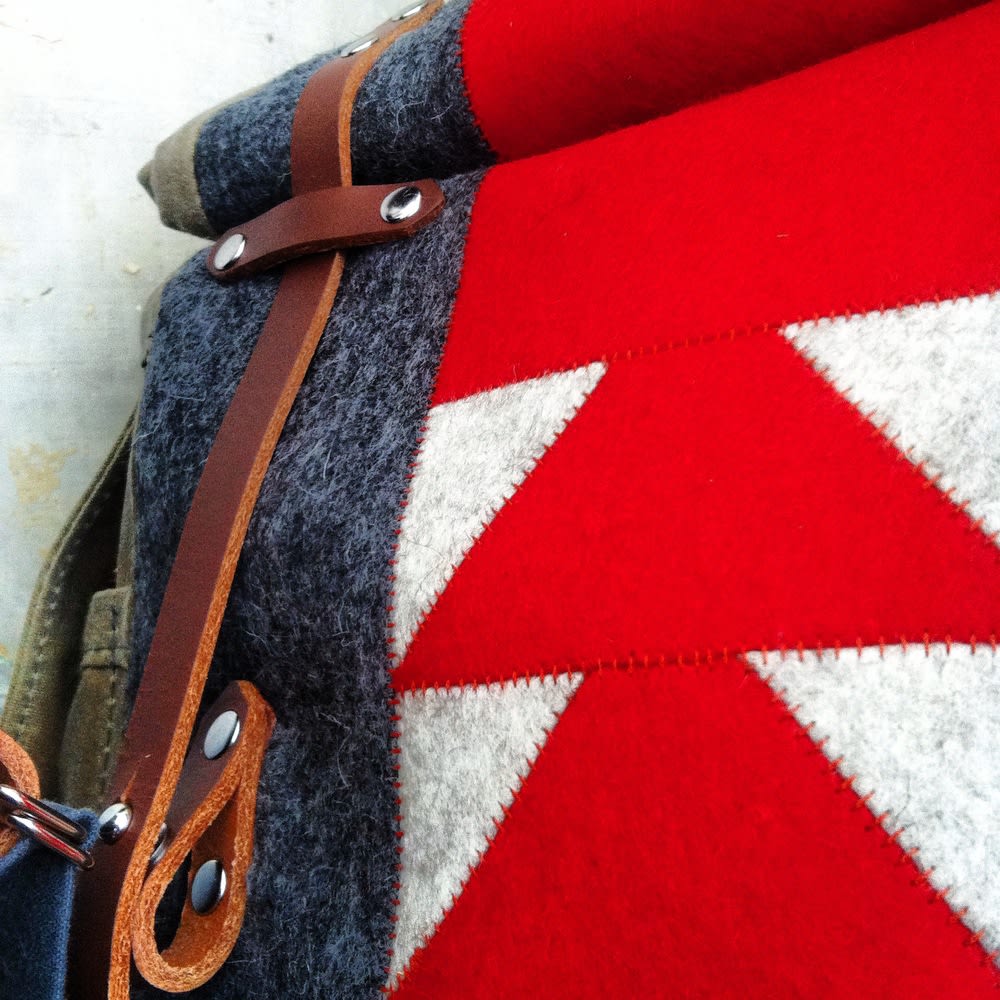
A folksy patchwork design mixes with the classic style roll top backpack. Sure to be unique, each shape is cut and sewn with matching stitches. Two expandable pockets on each side are adjustable and include convenient snap closures. The main compartment opening rolls up with leather straps which are adjustable in height to accommodate both large and small loads. The interior is lined with a neutral-toned and durable cotton canvas. Inside there are two additional pockets near the opening to keep smaller items accessible, and a compartment to carry your laptop securely and comfortably against your back. The shoulder straps have adjustable sliders and leather and canvas gussets at the base for strength — via Sketchbook Crafts
The Middleman: The Doomsday Armageddon Apocalypse
read by the reunited cast: Matt Keeslar, Natalie Morales, Brit Morgan, Mary Pat Gleason, Jake Smollett, Brendan Hines and special guest star Mark Sheppard at the 2009 San Diego Comic Con — via Youtube

The Internet Archive has long been one of the coolest sites on the web, thanks to its incredible collection of long-forgotten web pages and public domain films. They added home console games to the mix with the Console Living Room late last year, and now they’ve unveiled The Internet Arcade — a browser-friendly collection of classic arcade games that will blow your mind.
The list of games includes well-known titles like Frogger, Amidar, Joust, Lode Runner, Rally-X and Zaxxon along with hundreds of lesser known games — many of which had slipped my mind. Because the emulations use the original game ROMs, you’ll have to sit through a few seconds of power-up self tests and deal with odd control arrangements on a few titles. Thankfully, the Internet Archivists have created a page of games that should run at full speed on most hardware — via Retro Thing

Gehry Partners designed Biomuseo in Panama. The project comprises three main elements: the museum building, the exhibition design and the surrounding park — via ArchDaily
Do yourself a favour and check out this Countdown 40th birthday sketch in which HRH The Prince of Wales good-naturedly roasts Molly Meldrum — via Youtube
— via Youtube
Knot #802 is found on page 145 of The Ashley Book of Knots. Ashley says this is a two-strand version of knot #758, Captain Charles W Smith’s Sinnet Knot. A little more decorative and to further secure the knot, I sometimes add some whipping with smaller diameter cord around the end strands, or add some gaucho knots, as shown in the example pics in the video and blog post — via Youtube
At first, my mother was the only one who’d refuse to eat Grandma’s food, and I thought she was being paranoid. Then I started noticing that every time I went to Grandma’s, I’d pass out on the couch or on the train on the way back to the city. When I stopped eating Grandma’s food, my brother thought I was paranoid. But I stopped passing out, and pretty soon he stopped eating Grandma’s food too.
But here’s the thing: You don’t want to believe your grandmother is poisoning you. You know that she loves you—there’s no doubt of that—and she’s so marvellously grandmotherly and charming. And you know that she would never want to poison you. So despite your better judgement, you eat the food until you’ve passed out so many times that you can’t keep doubting yourself. Eventually, we would arrive for holidays at Grandma’s with groceries and take-out, and she’d seem relieved that we wouldn’t let her touch our plates. By then, her eyesight was starting to go, so she wouldn’t notice the layer of crystalline powder atop that fancy lox she was giving you.
So the question became: How did we explain to guests, outsiders, that they shouldn’t eat grandma’s food? One time, maybe on Passover, my brother brought his new girlfriend, an actress. Grandma had promised not to prepare anything, and it seemed she’d kept her word, so we didn’t mention the poisoning thing to the girlfriend, but after we’d eaten lunch, Grandma came out of the kitchen with these oatmeal raisin cookies that looked terrible. They were bulbous, like the baking soda had gone haywire. My brother’s girlfriend ate two of them, maybe out of politeness. We looked on, aghast. She had a rehearsal in the city, but she passed out on the couch and missed it — via redwolf.newsvine.com

By Ryan Hall — via PLANET-PULP
Jimmy Fallon challenges Daniel Radcliffe to rap Blackalicious’ tongue-twisting Alphabet Aerobics
— via Youtube

B-ILD transformed a dilapidated bunker into a holiday home for a promotion. Due to the success of the refurbishment, it was decided to keep the bunker permanently open for accommodation. The half-buried bunker lies on the site of the Fort Vuren in the Netherlands in a green surrounding — via ArchDaily
Alone at a downtown laundromat with a maniac… what would you do? — via Youtube

Scooter in profile originally uploaded by Red Wolf
A Girl Walks Home Alone at Night is the first Iranian Vampire Western ever made, Ana Lily Amirpour’s debut basks in the sheer pleasure of pulp. A joyful mash-up of genre, archetype, and iconography, its prolific influences span spaghetti westerns, graphic novels, horror films, and the Iranian New Wave — via Youtube

Laminated clear float glass with cast concrete base and cast white bronze lighthouse. H 450 x W 250 x D 250mm — via Broken Liquid

It is enough to make the neighbours green with envy and decline an invitation to tea. The vogue for a designer kitchen is set to be eclipsed with the sale of items unheralded in the competitive world of interior design: a fitted kitchen by Charles Rennie Mackintosh.
In what is believed to be a world first, a selection of kitchen units designed by the celebrated architect and designer is set to go up for auction next month with an estimated price for the collection of £20,000. Lyon & Turnbull, the Edinburgh auction house, will be auctioning off three lots which previously made up the kitchen of The Moss, a house designed by the architect and built in Drumgoyne, near Killearn.
The three lots which make up the kitchen include a small pine kitchen dresser valued at £400 to £600, a large pine kitchen dresser valued at £3,000 to £4,000 and a substantial range of kitchen cupboards and work tops whose estimated value is between £3,000 and £5,000. The kitchen collection will be sold on 29 November at Lyon & Turnbull’s Decorative Arts Sale in Edinburgh.
Charles Rennie Mackintosh famously believed no detail was too trivial to be beyond the eye of a true architect and on one occasion even specified what colour of cut flowers was permitted on the living room table so as not to clash with the rest of the decor.
The kitchen he designed for Sir Archibald Campbell Lawrie, who died in 1914, is set to attract bids from all over the world. What makes the set unique is that the kitchen units were removable as opposed to build into the fabric of the home — via redwolf.newsvine.com

My daughter’s eyes went wide. She was sold on the idea. This could happen. But then she turned and looked at me, But what are you going to be?
She thought for a second and said Well, if I’m a Han Solo, you should probably be Princess Leia, I guess…
She looked at me with an implied question in her eyes. And, c’mon, if I immediately told her YES, a girl can be Han Solo,
it would’ve been pretty hypocritical of me to say Nope, a boy can’t be Princess Leia.
So, as quickly as I could, I said, That would be FANTASTIC. I totally should be Leia.
And that’s exactly what I did. Because that’s what dads do — via The Good Men Project

Denver Zoo recently celebrated the birth of its very first Fossa (FOO-sah) pup! Born 28 July, the male Fossa pup, Rico
, stayed behind the scenes for his first couple months, under the watchful, attentive eye of his mother, Violet
— via ZooBorns


 RSS – Posts