
::squee:: My Wolf + Declán commission from Ben Templesmith arrived


— via owlturdcomix

British Columbia, Canada is known for many things: beautiful landscapes, great skiing, the 2010 Winter Olympics — and the human feet that have been washing up on its shores for the last nine years.
Since 2007, 12 human feet clad in running shoes have been found on the shores of British Columbia, from Jedediah Island to Botanical Beach. So far, the provincial coroner’s office has identified eight of the 12. Of those eight, two were pairs. The remaining lone feet, the coroner determined, belonged to men.
It had been nearly four years since a foot sighting, and then on 7 February a new one washed ashore, discovered by a hiker along Vancouver Island’s Botanical Beach. Five days later, another one appeared. The coroner’s office confirmed they were a pair — via redwolf.newsvine.com
Anne Rolland Architecte designed the renovation of Studio Li, a mid-seventeenth century mansion townhouse in Paris, France — via ArchDaily
A leading scientist has declared homeopathy a therapeutic dead-end
after a systematic review concluded the controversial treatment was no more effective than placebo drugs.
Professor Paul Glasziou, a leading academic in evidence based medicine at Bond University, was the chair of a working party by the National Health and Medical Research Council which was tasked with reviewing the evidence of 176 trials of homeopathy to establish if the treatment is valid.
A total of 57 systematic reviews, containing the 176 individual studies, focused on 68 different health conditions — and found there to be no evidence homeopathy was more effective than placebo on any.
Homeopathy is an alternative medicine based on the idea of diluting a substance in water. According to the NHS: Practitioners believe that the more a substance is diluted in this way, the greater its power to treat symptoms. Many homeopathic remedies consist of substances that have been diluted many times in water until there is none or almost none of the original substance left — via redwolf.newsvine.com
The sequel to the 2014 Dazzler music video, I Will Steal Your Heart
sees the New Mutants attending a concert by Lila Cheney, the hottest underground rock act in the galaxy! For more info, check out our site at Superhero Pop — via Youtube
Captain Eric Winkle
Brown, the pilot who flew more types of planes than anyone in history, has died in Britain at the age of 97.
Described as the Scotsman whose real-life adventures made James Bond’s fictional life seem dull, Captain Brown held the world record for flying the greatest number of different types of aircraft — 487.
He landed on aircraft carrier decks more times than any pilot in history, with 2,407 landings over the course of 65 years, and also led an elite British unit charged with testing captured Nazi experimental planes at the end of World War II.
Aviation experts say the records set by the Navy test pilot and war hero are unlikely to ever be broken — via redwolf.newsvine.com

Delft clay casting is just one of many methods to cast metal objects. Delft clay casting has some drawbacks but is arguably the most accessible casting medium for those who are just starting out — via Instructables

This UKWMO (United Kingdom Warning and Monitoring Organisation) base offers an intriguing piece of Cold War History, with a wood-burning stove and retains well-preserved relics relating to its history. Accommodation The underground accommodation comprises of a main room, measuring approximately 2.32 metres by 4.61 metres and a small subsidiary chamber, currently utilised for storage, which would be suited to development into a washroom facility — via Rettie & Co

A statuette from the John Huston-Humphrey Bogart classic The Maltese Falcon is one of the most recognisable, and sought-after, pieces of movie memorabilia in history. In fact, Steve Wynn paid $4.1 million for it. But was it the genuine article? Bryan Burrough tracks down a flock of Falcons, with links to both Leonardo DiCaprio and a famous Hollywood unsolved murder.
Aong with the ruby slippers Judy Garland wore in The Wizard of Oz and Orson Welles’s Rosebud
sled, which burns in the final frames of Citizen Kane, there is probably no more iconic item of Hollywood memorabilia than the Maltese Falcon, the black statuette that Humphrey Bogart, as detective Sam Spade, tracked down in John Huston’s classic film of the same name.
Lost to history for decades, it resurfaced in the 1980s in the hands of a Beverly Hills oral surgeon, and beginning in 1991 traveled the world as part of a Warner Bros. retrospective, with stops at the Centre Pompidou, in Paris, the Museum of Modern Art, in New York, and elsewhere. In 2013 it was offered for sale by Bonhams auction house. There was talk it might go for $1 million or more. But at the auction in Bonhams’s Madison Avenue showroom on November 25, 2013, the bidding quickly passed $1 million, then $2 million, then $3 million. Spectators gasped as a bidder in the audience dueled with one on the telephone, driving the price higher and higher.
Only when the bidding reached $3.5 million did the bidder in the crowd surrender, sending the Falcon to the man on the phone, who was later revealed to represent Steve Wynn, the Las Vegas hotel and casino billionaire. With the buyer’s premium, the total price came to a stunning $4.1 million. The crowd burst into applause. The auctioneers wheeled out a tub of champagne bottles to celebrate.
And with good reason. It was one of the highest prices ever paid for a piece of movie memorabilia, and two of the others were for cars: the original Batmobile, which had sold for $4.6 million earlier that year, and the Aston Martin Sean Connery drives in Goldfinger. News of the Falcon sale was carried on the network news and in newspapers around the world. Today it sits, along with a pair of Picassos, a Matisse, and a Giacometti sculpture, in a meeting room in Wynn’s Las Vegas villa.
That is the official version of what happened to the Maltese Falcon. But it is just one chapter in a complex tale. It turns out there is another, far stranger version, and another Falcon, several more in fact. And this version, which draws in characters as diverse as Leonardo DiCaprio and the woman butchered in one of Hollywood’s greatest unsolved murders, constitutes a real-life mystery every bit as bizarre as the one Sam Spade confronted on film — via redwolf.newsvine.com
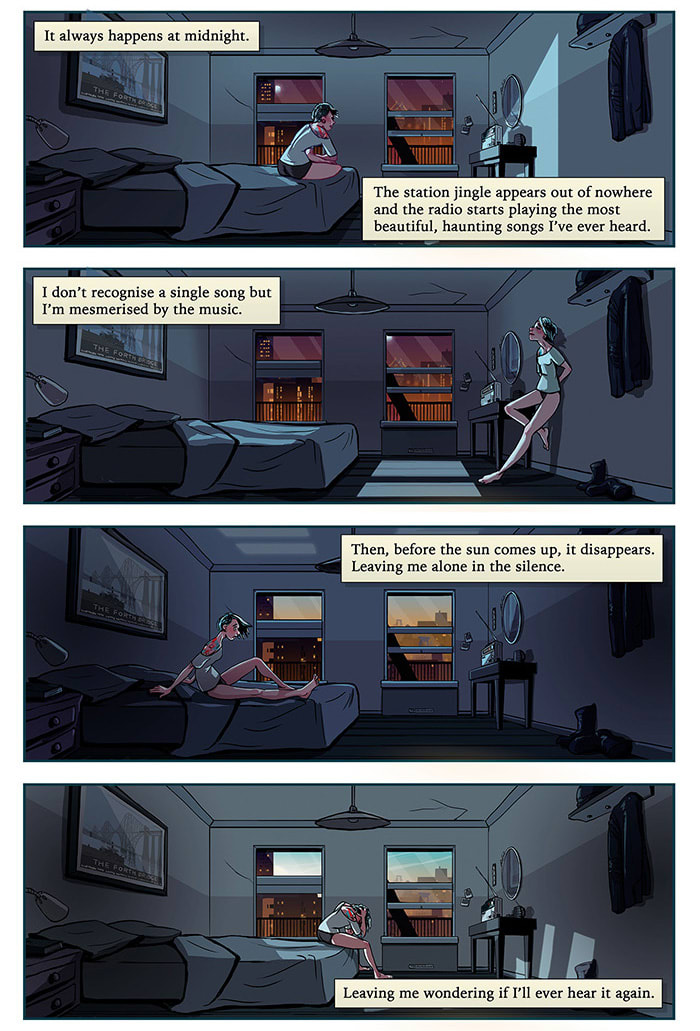


Midnight Radio. Written by Ehud Lavski. Art by Yael Nathan. If you like it, please share. Contact: elavski@gmail.com — via EL Comics
200,000 fish bones discovered in and around a pit in Sweden suggest that the people living in the area more than 9000 years ago were more settled and cultured than we previously thought. Research published in the Journal of Archaeological Science suggests people were storing large amounts of fermented food much earlier than experts thought.
The new paper reveals the earliest evidence of fermentation in Scandinavia, from the Early Mesolithic time period, about 9,200 years ago. The author of the study, from Lund University in Sweden, say the findings suggest that people who survived by foraging for food were actually more advanced than assumed — via redwolf.newsvine.com
Ground-level view of construction on the six central towers of the Sagrada Família — via Youtube

A unique Tuatara has hatched at Chester Zoo. It is a species believed to have pre-dated the dinosaurs, having been on the planet more than 225 million years. This is also the first ever breeding of Tuatara outside of their native New Zealand. The egg from which the youngster hatched was laid on 11 April 2015, and it hatched on 5 December. The rare newcomer arrived weighing 4.21 grams — via ZooBorns
Young men are particularly liable to become fanatics. Every dictator, every guru, every religious leader, knows this. Fanatics have an overwhelming sense of identity based on a cause (a religion) or a community (gang, team), and a tight and exclusive bond with other members of that group. They will risk injury, loss or even death for the sake of their group. They regard everyone else as outsiders, or even enemies. But why are so many of them young males? — via Aeon

Leafy sea dragons are in the same family as the sea horse. They are delicate and whimsical creatures. Sea dragons are some of the most ornately camouflaged creatures on the planet. Hiding in meadows of seagrass. This sculpture is a free standing sculpture, allowing it to be displayed almost anywhere. Creating this sculpture was a challenge for sure, and required a complex system of moulds to capture my sculpture — via Etsy


— via Obvious Plant

Getting your kids to put away their toys every time is nearly impossible, and nothing is worse than stepping on a stray Lego brick. Make them this Lego play table to give them a space to build with (and put away) their bricks — via Lil’ Luna

3D Felt Squid Brooches originally uploaded by Hine

The 1970s was a decade of social tension. Environmental disaster, terrorism, war and foreigners were a constant threat. Many citizens and some of their friends expressed concern about what would happen if the worst came to the worst.
In 1979 the government declared that it was fully prepared for any eventuality. A series of posters and leaflets introduced Pre-Emergency Services which had been set up to supply citizens with essential survival items
including ping pong balls, rubber bands (see poster above), furniture polish, drinks coasters and crocheted toilet-roll covers that looked like Georgian ladies — via Scarfolk Council


 RSS – Posts