Eastern Black Rhino / Cleveland Metroparks Zoo

A Eastern Black Rhinoceros calf was born on 1 July at Cleveland Metroparks Zoo, and it’s a boy! The calf weighed about 36 kg at birth and is growing fast. In just four weeks he now tips the scales at about 68 kg. When fully grown he will weigh about 1,360 kg! Animal keepers will give mother and baby time to bond and hope they can be put on exhibit shortly in the Zoo’s African Savanna — via ZooBorns

Giant Anteater / Busch Gardens

A baby Anteater was born in June at Busch Gardens in Tampa, Florida. Keepers are not yet sure if the little one is male or female but once they are able to identify the gender, it will be named. Just over a month old, the pup currently weighs less than 2.26 kg but will grow up to weigh more than 45 kg — just like its parents, Adelhi (mother) and Buddy (father) — via ZooBorns

Deep-Sea Squid Detach Arms When Faced With Predators or Prey

Researcher Stephanie Bush recently observed Octopoteuthis deletron deep-sea squid detaching their arms when faced with predators or prey (video). The bizarre behaviour is not unknown in the animal world (lizards and octopus are known to jettison limbs), but it is a first for squid. Octopoteuthis deletron are full of surprises—last fall researchers reported same-sex sexual behaviour in the little squid — via Laughing Squid

Bayfield photographer’s photo goes viral

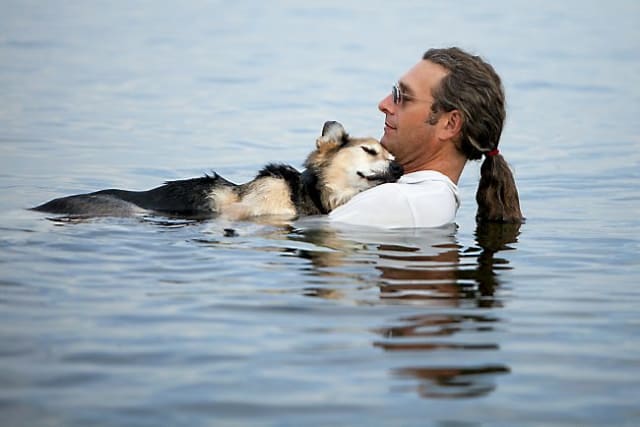
Schoep + John Unger / Hannah Stonehouse Hudson

It’s an image that’s hard to look at without smiling.

A dog sleeps in blissful repose, head rested against the neck and shoulder of a pony-tailed man standing shoulder-deep in water. The man appears in profile, and he wears dark glasses, but his eyes seem to be closed. The smile on his face matches the dog’s contentment.

The photo has drawn the attention of thousands of people since being posted on Facebook last week. The story behind the photo is touching.

Professional photographer Hannah Stonehouse Hudson took it off Bayfield’s Reiten Beach in Lake Superior on Tuesday. The man is her friend John Unger. The dog, an ageing, arthritic shepherd mix, is named Schoep, after a brand of ice cream that’s popular in southern Wisconsin (the dog likes vanilla) — via redwolf.newsvine.com

Bat-eared Foxs / Prague Zoo

Prague Zoo has a new litter of Bat-eared foxes. The first weeks of their lives involve snuggling close to mum within a safe underground burrow, but the quintuplets are now venturing out into their exhibit. The adult foxes in the zoo’s Bat-eared Fox family must patiently endure love bites and playful attacks from their young during these first weeks — via  ZooBorns

European Lynx / ZSL Whipsnade Zoo

One proud set of parents at ZSL Whipsnade Zoo have three reasons to celebrate this summer: the birth of European Lynx kitten triplets. The all-female trio, born in June to parents Maja and Timo, have spent their first weeks of life tucked up in their den but have just now begun to explore outside. This is the second litter of Whipsnade’s rare European Lynx, one of Europe’s largest predators — via ZooBorns

Thieves target acclaimed wildlife photographer

One of Australia’s best-known wildlife photographers has had most of his photographic equipment stolen from a car.

Steve Parish was staying with his nephew at suburban Norwood in Adelaide and found his car windows smashed when he woke this morning.

About $200,000 of equipment was gone and Mr Parish admitted it was uninsured.

They’ve stolen my prized cameras. Some of the lenses are special lenses that I’ve had for a long time, they’re not actually manufactured any more, he said.

They don’t really have any market value but they have a lot of special micro-zoom lenses for photographing animals — via redwolf.newsvine.com

For flock’s sake: Scared sheep send SMSes to Swiss shepherds

Swiss boffins have been testing SMS-equipped sheep to see if they can send a warning text message when the big, bad wolf approaches, and it looks like they can.

The sheep don’t voluntarily send the message, but a heart-rate monitor fitted to a sheep’s collar can detect when the animal is stressed, and automatically sends an SMS message when that stress gets high enough, hopefully allowing swift intervention from the shepherd.

The trials, reported by the AFT, involved only 10 sheep who were fitted with collars and threatened with wolfdogs. Even the muzzled hounds were able to send the sheep into enough of a panic to trigger the text message, and the plan is to run (literal) field trials early next year — via redwolf.newsvine.com

Octo-labra / Source Collection

Our impressive octopus candelabra, or Octo-labra has eight fabulous tentacles, four of which hold standard tapers. The expressive movement, intricate anatomy, and wondrous form of the cephalopod are captured in the finest pewter. The fabulous styling reminds us of 19th century New England whaling tales featuring these feared creatures from the deep — via Source Collection

Spotted Hyena / Colchester Zoo

On 20 June, Colchester Zoo’s breeding Hyena pair produced the zoo’s first ever zooborn Spotted Hyena! In 2011 Colchester Zoo became the first Zoo in the UK to house the species and so they are overjoyed that they’ve been able to breed successfully. The new arrival can be elusive, so you may have to wait to catch a glimpse. It spends much of its time in a den with mum now, but has occasionally been seen out on exhibit by keepers — via ZooBorns

Can we do more with trees in streets?

This street in Melbourne’s Sunshine West (first exhibit) would look a lot more attractive if it had trees like this street in Melbourne’s north-east.

Some residents and local authorities think trees are too much trouble. They require attention to get started and are vulnerable to vandalism in their early years. Their roots interfere with services and foundations; their branches snag power lines; and their leaves, bark and seeds clog gutters.

Certain species drop death-sized branches from time to time. Natives perform well in drought conditions but block sunlight to houses in winter. In established areas with narrow streets new plantings will sometimes be at the expense of parking spaces.

However the benefits of trees far exceed their cost. Urban designer Dan Burden reckons it costs between $250 and $600 in the US to establish a tree over three years, but the direct benefits over its lifetime exceed $90,000 (excluding aesthetic benefits).

The NY State Department of Environmental Conservation estimates each mature tree removes around half a tonne of carbon dioxide and about 100 kg of pollutants from the air each year. Trees can lower home and vehicle cooling costs, improve residential amenity, and increase property values — via redwolf.newsvine.com

Human Teeth as Hard as Shark Teeth

Even though your teeth are largely composed of a mineral softer than that found in sharks, new tests reported in the Journal of Structural Biology suggest that they’re just as tough. In sharks, the material coating the teeth is largely composed of fluoroapatite, a fluoridated phosphate mineral that in its pure form is harder than the hydroxyapatite found in the enamel of human teeth. But by pressing tiny metallic pyramids into the surfaces of teeth from a shortfin mako shark (Isurus oxyrinchus, shown) and a tiger shark (Galeocerdo cuvier), researchers found that the enameloid coating on shark teeth is no harder than that of the enamel on a human wisdom tooth. The teeth are, in fact, of comparable hardness because their surfaces aren’t pure mineral but instead are made of mineral crystals bound together with proteins so that the material doesn’t shatter under a sudden impact — via redwolf.newsvine.com

Pudu Fawn / Bristol Zoo Gardens

A baby Pudu, the world’s smallest species of deer, recently made his debut at the UK’s Bristol Zoo Gardens.

This male Pudu was born 6 May and has recently ventured out into his paddock for the first time.

The fawn weighed only about 1kg at birth. At one month, he weighed only 1.8kg — about half the weight of a newborn human baby! The tiny youngster is part of an international conservation breeding program. As with all Pudu fawns, he has distinctive white spotted markings on his back which help to camouflage him from predators — via ZooBorns

Cougar / Zoo Sauvage

Keepers at Zoo Sauvage in Quebec, Canada suspected the arrival of a newborn Cougar when they observed a change in one of their female’s behaviour. The confirmed birth of a new cub has keepers excited but cautious, so mother and cub have been separated from the other Cougars on exhibit — via ZooBorns