Felted wool balls – did you know you can use them in the dryer in lieu of dryer sheets, they also make great kids and cats toys – you can use them for pin cushions and jewelry – the list goes on – here is a tute to help you make some — via Whip Up
The East Meets West Sofa by Tonio de Roover looks like a flying carpet– via CRAFT
Antique furniture deserves something better than an occasional dusting with a spray polish. Real wood needs real nourishment, and nothing brings wood to life better than traditional beeswax polish.
The first time that I tried home-made polish, I was amazed how much it transformed the appearance of the table that I was working on. I could see my own reflection in the rich grained mahogany surface after just a few minutes of polishing. Encouraged by the results of my effort, I spent the next few hours applying beeswax polish to every piece of furniture that I could find — via CRAFT
This tutorial for a flannel swaddling blanket from Sachiko of Tea Rose Home uses a self-binding technique that looks really interesting — via CRAFT
I am totally swooning over this amazing felt container from A Ervilha Cor de Rosa (a great Portuguese craft blog if you don’t know it already). I love the sturdy felt paired with the frilly edging, the rounded shape with the zipper in the middle, the unexpected matching of brown and gray and red … everything about it, really! What a fun little container for carrying projects around in or storing some of your less-lovely-to-look-at craft materials. (Fingers crossed Rosa puts some in her shop!) — via CRAFT
Jennifer Ackerman-Haywood of CraftSanity shows how you can turn an old book into a weaving loom by pounding nails in to the cover. She even shares a project from a woman named Margaret Jager who created a beautiful shawl from squares woven on her own book loom. Margaret’s response to Jennifer’s question of why Margaret would use a knitting book to create her loom is priceless. Check out Jennifer’s post to see Margaret’s answer and the tutorial for making your own book loom — via CRAFT
This awesome Star Wars cross-stitch baby blanket and pillow were created by Flickr user, Kiddy Amunda, as gifts for a friend’s baby. What a cool heirloom for this family! Kiddy Amunda is also the genius behind the amazing Logan’s Run cross-stitch pillow we featured back in July — via CRAFT
There is something warmly familiar and comforting about the quiet chatter of women and the clickety-clack of knitting needles — via redwolf.newsvine.com
A note from Kathleen: I’m busily taking photos for the Interweave Knits Fall Galleries, and I’m here to say that everyone LOVES the Breacan Swing Coat. It’s flattering to so many figure types and the weight of it is perfect for fall to early-winter—even here in Spokane where winter can come on like a lion! Almost everyone in the galleries loved this coat, and when asked what they would change, they said “nothing” or ” try a different color combo.”
So I’m really excited that editor Eunny Jang chose it for her sweater workshop for this issue of Knits. She’s here to talk about the coat in-depth, including tips on color combinations!
 |
|
| The Breacan Swing Coat |
The Breacan Swing Coat
Gwen Bortner’s Breacan Swing Coat in the Fall 2010 issue of Interweave Knits is a real stunner—on every level. Let’s break it down.
1) Silhouette. The swing coat shape is a classic, for good reason—fitted at the shoulders for neatness but generously proportioned at the hem, swing coats flatter nearly everyone.
A dramatic collar and buttons keep the attention above the waist, while the extra room provided by the A-line shape and open bottom ensures that the coat moves well and doesn’t bind, even if you’re sitting down.
Swing coats focus attention on the slenderest parts of hourglass- and pear-shaped bodies, give gentle curves to those with straight figures, and skim over pregnant bellies—it’s a wonderfully versatile shape that makes for a practical, pretty staple.
 |
 |
 |
|||
| Straight figures | Curvy figures | Mommas-to-be |
2) Yarn. The sample sweater uses a lofty, organic, merino singles yarn, Zitron Nimbus—it’s just one step removed from untwisted roving, making it wonderfully light and soft. Because this jacket requires double stranding the yarn throughout, the extra loft helps keep the fabric wearable.
 |
|
| Two-color combo |
|
 |
|
| Four-color combo |
|
3) Technique. Gwen riffs off woven tartan with the fabric of this jacket: Horizontal and vertical stripes join and split to form areas of intense color and areas of marl. Working with two colors, say yellow and gray, this gives you three color options: solid yellow, solid gray, and yellow-and-gray marl. This type of pattern is often worked with stranded colorwork, which has a finite limit on the number of colors that can be carried per round.
In this jacket, Gwen approaches the same idea in a different way: The jacket is worked in vertical intarsia stripes and plain horizontal stripes at the same time. This increases the number of possible vertical colors to, theoretically, as many as you want. At the same time, the jacket is worked with two strands held together throughout, which mixes vertical and horizontal color stripes in a very simple and graphic way.
The Breacan Swing Coat uses just four colors of yarn—two brights and two grays. Each color is used both as a vertical stripe and as a horizontal stripe. The finished fabric, however, has ten unique colors in it, since every color is at some point combined with every other color.
4) Color fun! Because the color formula for this jacket is so easy to understand but produces such a rich-looking result, it’s a great canvas for experimentation. The basic formula of two neutrals plus two brights in the same color family is a good place to start.
Or you could use two brights in different families; or you could get rid of your neutrals and use all brights; or you could go understated in elegant neutrals! We’ve done some magic below to show you how these combos might look:
 |
 |
 |
 |
| Two neutrals + two brights | Two brights in different families | Four brights | Four neutrals |
The choice is yours. At Interweave Knits, we love sweaters that you can put your own stamp on—subscribe now and make sure you don’t miss your perfect sweater.
How will you knit the Breacan Swing Coat? Leave a comment below and let us know.
Cheers,

— via Knitting Daily
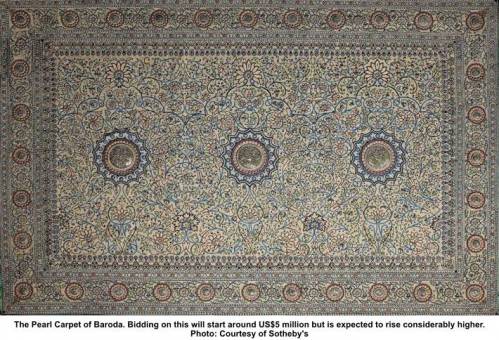
The carpet, slightly over 5? x 8? in size, was commissioned by the Maharajah of the Indian state of Baroda in 1865.
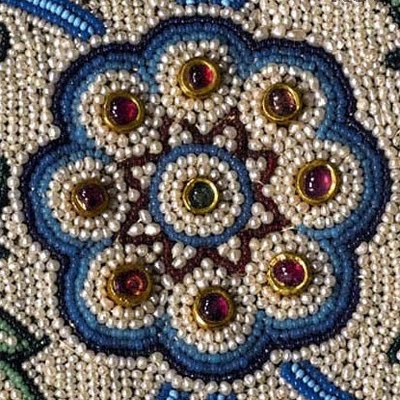
This splendid carpet has a surface that is entirely embellished, created using an estimated two million natural seed pearls, known as “Basra” pearls originally collected in the waters of the Gulf. The design is picked out in coloured glass beads and the whole richly encrusted and embellished with gold set diamonds and precious stones in their hundreds… Across the centre there are three large round ‘rosettes’ each made of table cut diamonds set in silvered gold. Further smaller diamond rosettes in the border, all of which are embellished with sapphires, rubies and emeralds set in gold.
The carpet was publicly displayed at the Delhi Exhibition in 1902, and at the Metropolitan Museum of Art in 1985. In 2009 it sold at a Sotheby’s auction for $5.5 million — via Neatorama
Need extra seats at your house because you’re the only one of your friends getting Portal 2? Make a companion sitting cube!
After weeks and months of free time, let this Instructable accompany you back into Real Life. Wipe the dust from your desk chair and find out that it does absolutely not fit to the clean and sober atmosphere you want to dispense with your homework. What could be more engaging and mind-stimulating than a multi-purpose Companion Sitting Cube?
Ready for the release of Portal 2 , here is the Instructable to sew and glue your own Companion Cube as a desk stool, gaming taboret or side table.
— via CRAFT
If you’re around and about London, enamoured with invertebrates generally, and have always wondered if knitting and you were meant to be; well, here’s the perfect opportunity to find out. This Friday evening (August 27th), from 6pm to 9:30pm, at London’s Natural History Museum, Stitch London will be on hand at to show the public how to make anatomically plausible sea life (with “probably the easiest knitting pattern ever”). This will be part of the last of the museum’s summer after hours evenings. As well, it sounds like they’re working on something big!
Come and see Stitch London’s incredible knitted giant squid on display in the Central Hall. The giant knitted sea creature is a replica of our famous 8m giant squid specimen, Archie, held in the Museum’s Zoology Spirit Collection. Amazingly, the huge knitted Archie is being created with orange yarn made from recycled plastic bags!
Back to school doesn’t have to mean back to school shopping. Instead, DIY! I love fashion trends, but I also hate having to keep up with them if it means spending money. Generally I choose classic-looking clothes and I try to limit my trendiness to a few select accessories. Luckily, one of the hottest scarf designs this season is ridiculously easy and fun to sew. I spent $1.20 on the elastic thread, and in 5 minutes I had stitched up my new favorite scarf out of some jersey I had lying around. I had a blast making it too!
If you are nervous about sewing with elastic, don’t be! It’s so easy. Don’t be concerned about making the lovely gathers, either. There is nothing to fear. This project is the perfect chance to sew crazy freeform swoops without worrying about anything at all — via ç
Nicole Mallalieu clears up any interfacing issues you might have — via Whip Up
Here’s the latest from sculptor and CRAFT friend Moxie– a series called Hungry, for Plush You! LA at Munky King Gallery, Aug/Sep 2010 — via CRAFT
Jan DiCintio of Daisy Jane shares a tasty-looking recipe for these oat-free, grain free trail bars.
Why no grains? The answer is multi-layered, but here’s the basic idea. We work hard and workout harder – we live life fully and need foods that keep us feeling light and spry. Through experimenting with our diet, we observed that grain foods tend to make us feel full, bloated and lethargic. Although we’ve always eaten healthfully, we still felt like there was something else – something we weren’t getting right – that would allow us to harness and maintain regular energy levels rather than sapping them. In addition, I have an intolerance to grains, esp oats, that had worsened markedly this past year. I cut out all grains to see if my symptoms were alleviated, and wow – what a difference! Symptoms gone and tons of energy to boot! We don’t miss it at all!
— via CRAFT
Japanese crochet artist jungjung made these fabulous crochet broccoli and cauliflower heads. They’re part of an exhibition of crochet lace that also includes a carrot with delicate crochet greens. [via 203gow] — via CRAFT
Cindy at Skip to My Lou shares a really cool technique for braiding ribbon and applying it to a headband. She mentions the braided ribbon could be applied to any object or accessory, and could even be done in two tones of ribbon — via CRAFT
Miniature shrimp are adhered together to form Shrimplace, a piece by Tara Bursey. [Thanks, Garth!] — via CRAFT


 RSS – Posts