History

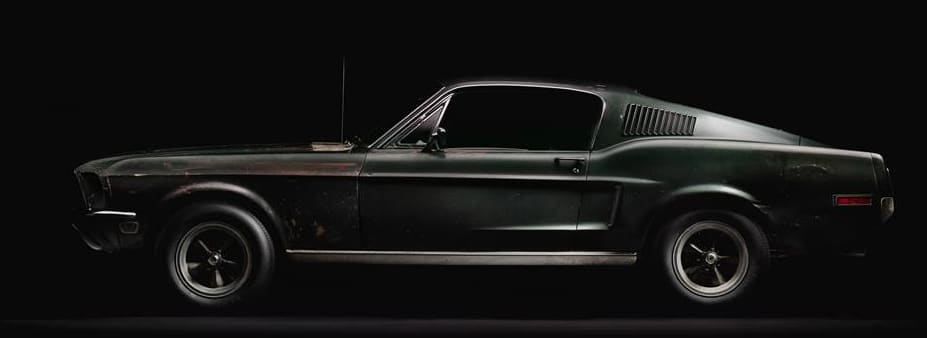
Found: the real Bullitt Mustang that Steve McQueen tried (and failed) to buy

Steve McQueen made one last effort to buy his favourite Mustang in 1977. He sent a letter, typed on a single piece of heavy off-white vellum, to the car’s owner in New Jersey. The logo for his movie company, Solar Productions, was embossed in the upper left corner and opposite that resided the date, 14 December 1977. The letter is just four sentences.

Again, it begins, I would like to appeal to you to get back my ’68 Mustang. McQueen offered no specifics as to why this particular Ford was important to him, except to say that he wanted to keep it unrestored and that it was simply personal with me.

McQueen’s star may have dimmed by 1977, but he remained an icon, a rare actor loved by both genders. McQueen was also one of us, an aficionado and a racer, someone who understood the instinctual joy of automobiles and motorcycles and indulged in both. And with that ’68 Mustang, McQueen gave us a gift, one of the greatest car chases ever filmed, a duel with a Dodge Charger up, down, and around San Francisco. The Bullitt chase is coveted for the usual crashes and jumps, but it had something more: Unlike most cinematic chases that feature cars performing impossible feats, the one from Bullitt was every bit as exciting, but the driving was obviously real. Those who know cars knew. It’s 10 minutes of film nirvana. McQueen wanted the Bullitt Mustang back.

The rich and famous are often allergic to the word no, and so was McQueen. His impatience over being rebuked in his quest emerged in the last sentence: I would be happy to try to find you another Mustang similar to the one you have, he wrote, if there is not too much monies involved in it. Otherwise, we had better forget it.

The owner was just fine with forgetting it, and then the Bullitt Mustang made an exit, stage left, from recorded history — via Hagerty

Art

Geometric Pattern: Triskelion Fork / Red Wolf

— by Red Wolf

Wildlife

Mountain Lion Orphans / Oakland Zoo

In cooperation with the California Department of Fish and Wildlife (CDFW) and the Feline Conservation Centre, Oakland Zoo has taken in two orphaned Mountain Lion cubs. The cubs were found separately in Orange County, two weeks apart from each other. Due to their ages and geographic proximity to each other when rescued, Oakland Zoo veterinarians will conduct DNA testing to determine if they are, in fact, siblings — via ZooBorns

Art

Geometric Pattern: Cross / Red Wolf

— by Red Wolf

Wildlife

Malayan Tiger Cubs / Prague Zoo

Two Critically Endangered Malayan Tiger cubs at the Prague Zoo are beginning to show their personalities. The cubs — one male and one female — were born on 3 October and only recently came out of the den with their mother, Banya. The animal care team chose the name Bulan for the male and Wanita for the female — via ZooBorns

Entertainment

Einstein-Rosen / Olga Osorio

Summer of 1982. Teo claims he has found a wormhole. His brother Óscar does not believe him — at least not for now.

Written and directed by Olga Osorio

With Teo Galiñanes, Óscar Galiñanes, Xúlio Abonjo, Ricardo de Barreiro — via Vimeo

Wildlife

Baird’s Tapir / Franklin Park Zoo

The calf was born at Franklin Park Zoo at 3.06pm on 1 January 1 to Milton, a 28-year-old male, and Abby, a 13-year-old female. This is the fourth offspring for Milton and Abby. Given the small size of the North American captive population, this is a very important birth for this endangered species — via Youtube

Design

Neko Modern Cat Tree / Rinn + Yoh Komiyama

Reconsidered and redesigned from the bottom up, the Neko Modern Cat Treelooks comprises a modernist architectural sculpture for a mere 1 million yen (that’s nearly €6,500 and $7,500!). The piece has been created by cat product company RINN who teamed up with Japanese designer Yoh Komiyama — via designboom

Art

Geometric Pattern: Weave / Red Wolf

— by Red Wolf

Wildlife

Jaguar Cubs / Houston Zoo

The Houston Zoo’s four-month-old Jaguar cubs recently made their public debut. Fitz and his sister, Emma, were born to first-time parents Maya and Tesoro on 20 July. The cubs have been behind-the-scenes with mum the past few months — via ZooBorns

Craft

UFO Chicken Coop / B&E

A couple in Idaho who go by B&E raise chickens, but they are also artists. When they expanded their flock, they decided to build a UFO chicken coop. Two satellite dishes and a trampoline frame later (plus a lot of work), it was ready for the chickens. The coop has windows, surveillance cameras, insulation, ventilation, heaters, and for the alien landing effect, plenty of lights — via Neatorama

Craft

Dark Ages Crossbow / Tod Todeschini

In this video Tod talks about the Colletière à Charavines light hunting bow, one of a very few surviving European crossbows from this period (around 1000AD). This is a very simple bow with only a few components. It could be constructed with European woods such as ash and yew and basic hand tools by any back woods bodger — via Youtube

Art

Geometric Pattern: Cube Split / Red Wolf

— by Red Wolf

Science, Wildlife

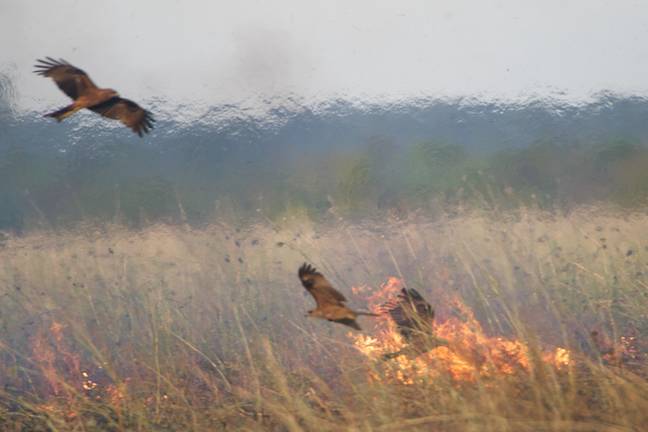
If Australian animals don’t poison you or eat you, they’ll burn down your house

Already replete with sharks, crocodiles, snakes and poisonous jellyfish galore, Australia may also be home to arsonist birds that spread fire so they can feed on animals as they flee.

The belief that birds like the Whistling Kite, Black Kite and Brown Falcon spread grass fires goes back so far that it’s commemorated in indigenous ceremonial dances, according to Bob Gosford, a co-author of this paper in the Journal of Enthnobiology.

The paper posits that the behaviour isn’t accidental: Most accounts and traditions unequivocally indicate intentionality on the part of three raptor species and a handful provide evidence of cooperative fire-spreading by select individuals from within larger fire-foraging raptor assemblages, it notes.

And while the researchers’ main interest was to confirm and document those stories, Gosford told Vulture South the research is also important to understanding how fire spreads in Australia.

This may give us cause to re-examine fire history, and the conduct of fire in this country, Gosford said — via The Register