For flock’s sake: Scared sheep send SMSes to Swiss shepherds

Swiss boffins have been testing SMS-equipped sheep to see if they can send a warning text message when the big, bad wolf approaches, and it looks like they can.

The sheep don’t voluntarily send the message, but a heart-rate monitor fitted to a sheep’s collar can detect when the animal is stressed, and automatically sends an SMS message when that stress gets high enough, hopefully allowing swift intervention from the shepherd.

The trials, reported by the AFT, involved only 10 sheep who were fitted with collars and threatened with wolfdogs. Even the muzzled hounds were able to send the sheep into enough of a panic to trigger the text message, and the plan is to run (literal) field trials early next year — via redwolf.newsvine.com

Protect Your Car Doors from Your Garage with a Pool Noodle

If you don’t have the space to fully open your car doors in your garage and sometimes hit the wall you may want to consider cutting a swimming pool noodle in half and bolting it to the wall.

This should avoid scratching your car doors as long as you don’t hit the bolt heads. I’d recommend taking a bit of leftover pool noodle material and gluing it to the bolt heads to prevent scratches from that surface — via Lifehacker

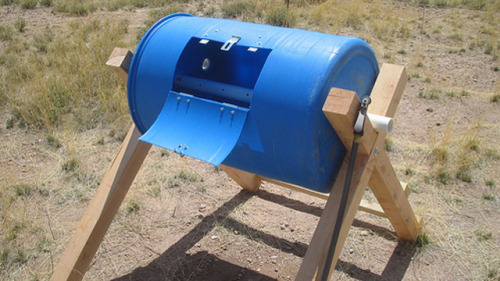
Build a Tumbling Composter

Instead of turning your compost pile with a shovel or pitchfork you can build a tumbling composter that will automatically turn and aerate your materials to help form a rich compost. Commercially tumbling composters can be expensive, but if you have access to large plastic drums you can make one or more tumblers on the cheap.

Instructional site WikiHow shares basic plans on how to turn a 55-gallon drum into a tumbling composter. Basically you’ll need to purchase a length of two-inch PVC pipe that’s two feet longer than your barrel. Drill holes in the top and bottom of the barrel to fit the pipe. Now create the stand for the composter by nailing two sets of 2x4s into an x-frame and nail two more 2x4s across the top of the X’s. You should now be able to set the barrel with pipe on the stand and turn it freely. Cut a door on the side of the barrel and use simple hinges and a hasp to attach the door back to the barrel. Finally, bolt a piece of sheet metal to the inside of the barrel opposite the door; this will give you a mixing fin to stir the compost as the barrel is tumbled — via Lifehacker

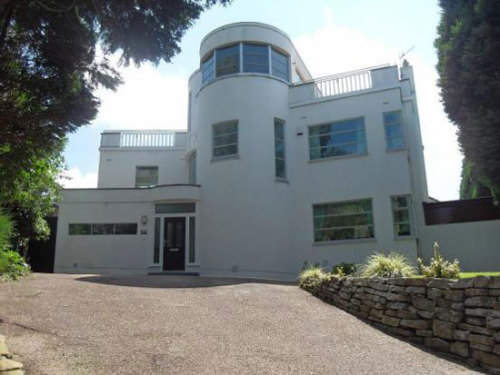
Art Deco House / Handforth, Cheshire

On the face of it, a lovely example of a period property. Sadly, that doesn’t carry over into the interior of this 1920s four-bedroom art deco house in Handforth, Cheshire.

That’s not uncommon, but it’s always slightly disappointing when someone has made a typical modern family home out of a distinctive build like this. Hard to criticise though — ultimately this is a house, not a museum.

The asking price is £525,000 — via WowHaus

Game of Thrones: How not to distribute content

The incredibly popular HBO series Game of Thrones is a fascinating case study. Not only in terms of constructing and maintaining dramatic tension in a TV series, but also in how not to distribute content.

It’s proof that content distribution needs a new model. The show has become not only one of the most successful series aired on the US subscription network, but more notably, it is the most pirated TV show of all time.

Moments after each episode screened on HBO in the US, record numbers of people were downloading the program on torrent sites. It averaged around 3m downloads per episode, a high proportion of them in Australia — via redwolf.newsvine.com

Watchdog clamps down on Facebook

A landmark ruling that Facebook is an advertising medium — and not just a way to communicate — will force companies to vet comments posted by the public to ensure they are not sexist, racist or factually inaccurate.

In a move that could change the nature of the social networking site forever, companies could be fined or publicly shamed for the comments that appear on their Facebook brand pages.

Last month the advertising industry watchdog issued a judgement in which it said comments made by fans of a vodka brand’s Facebook page were ads and must therefore comply with industry self-regulatory codes and therefore consumer protection laws — via redwolf.newsvine.com

Encrypt almost any disk in Mountain Lion

With Mountain Lion, you can now use the OS to encrypt disks other than the startup volume, assuming they are in GUID format. This includes USB flash drives and external Firewire/USB/ThunderBolt drives.

In the Finder, open a new window. Find your mounted (GUID) drive in the sidebar.

Control-click on the drive in the sidebar, then choose Encrypt. You are now prompted for your password and a hint (which is required). You will get no feedback, so wait for a few minutes; the time depends on the size of the drive.

The drive should unmount and mount again. Once this happens, your drive is encrypted — via Mac OSX Hints

OSX Command Line Tricks

OSX Mountain Lion changes a lot of small things with the way the operating system works. It also locks down a lot of default behaviours that many people were used to in OSX Lion. Thankfully, a group over at Github has compiled a huge list of the command line tricks that still work in Mountain Lion — via github

Octo-labra / Source Collection

Our impressive octopus candelabra, or Octo-labra has eight fabulous tentacles, four of which hold standard tapers. The expressive movement, intricate anatomy, and wondrous form of the cephalopod are captured in the finest pewter. The fabulous styling reminds us of 19th century New England whaling tales featuring these feared creatures from the deep — via Source Collection

1971 BMW R75/5 / Cafe Racer Dreams

For its latest build, Cafe Racer Dreams has taken a break from Triumph Bonnevilles. The Spanish workshop has turned its attention to the vintage BMW R-series — namely, the 749 cc R75/5 boxer. Now owned by Valéry from Paris, this 1971 model is a thorough resto-mod in the increasingly popular scrambler style. And it looks simply gorgeous — via Bike EXIF

Does Cybercrime Really Cost $1 Trillion?

These estimates have been cited on many occasions by government officials, who portray them as evidence of the threat against America. They are hardly the only cyberstatistics used by officials, but they are recurring ones that get a lot of attention. In his first major cybersecurity speech in 2009, President Obama prominently referred to McAfee’s $1 trillion estimate. Sen. Joseph Lieberman, I-Conn., and Sen. Susan Collins, R-Maine, the main sponsors of the Cybersecurity Act of 2012 that is expected to be voted on this week, have also mentioned $1 trillion in cybercrime costs. Last week, arguing on the Senate floor in favor of putting their bill up for a vote, they both referenced the $250 billion estimate and repeated Alexander’s warning about the greatest transfer of wealth in history.

A handful of media stories, blog posts and academic studies have previously expressed skepticism about these attention-getting estimates, but this has not stopped an array of government officials and politicians from continuing to publicly cite them as authoritative. Now, an examination of their origins by ProPublica has found new grounds to question the data and methods used to generate these numbers, which McAfee and Symantec say they stand behind.

One of the figures Alexander attributed to Symantec — the $250 billion in annual losses from intellectual property theft — was indeed mentioned in a Symantec report, but it is not a Symantec number and its source remains a mystery.

McAfee’s trillion-dollar estimate is questioned even by the three independent researchers from Purdue University whom McAfee credits with analysing the raw data from which the estimate was derived. I was really kind of appalled when the number came out in news reports, the trillion dollars, because that was just way, way large, said Eugene Spafford, a computer science professor at Purdue — via redwolf.newsvine.com

Krzywy Domek / Szotynscy & Zaleski

No, you’re not drunk, and no, this isn’t some kind of Photoshop trick. This is an actual building designed in 2004 by someone who had a little too much fun at architecture firm Szotynscy & Zaleski. Krzywy Domek (Crooked House) is a shopping center in Sopot, Poland, and those crazy curves are for real.

Inspired by the fairy tale illustrations of Jan Marcin Szancer and Per Dahlberg, Krzywy Domek looks like it leaped off the pages of a storybook — via Apartment Therapy

Spotted Hyena / Colchester Zoo

On 20 June, Colchester Zoo’s breeding Hyena pair produced the zoo’s first ever zooborn Spotted Hyena! In 2011 Colchester Zoo became the first Zoo in the UK to house the species and so they are overjoyed that they’ve been able to breed successfully. The new arrival can be elusive, so you may have to wait to catch a glimpse. It spends much of its time in a den with mum now, but has occasionally been seen out on exhibit by keepers — via ZooBorns

Kawasaki Z750 / Wrenchmonkees

Like all the top custom builders, the Wrenchmonkees have a clear and consistent vision. And this, bike #45 from the Copenhagen workshop, could be their best yet.

It’s a little less grungy than some of their earlier work, with glossy paint on the tank. But the low-key colours, blacked-out components and perfectly-judged stance make this Kawasaki Z750 instantly recognizable as a Wrenchmonkees build — via Bike EXIF

Peruvian police seizes $2.3m in fake bills

Police in Peru say they have seized $2.3m (£1.5m) in counterfeit notes.

They say the notorious Quispe Rodriguez family clan is behind the production of fake currency.

Peruvian police chief, Raul Salazar, said the gang was planning to smuggle the counterfeit $50 bills into the United States, hidden inside Peruvian souvenirs.

The US says Peru is the largest foreign producer of counterfeit dollars — via redwolf.newsvine.com

Tietgen Student Hall / Lundgaard & Tranberg Arkitekter

Located on Orestad, a newer district in Copenhagen, Denmark, lies the award-winning Tietgen Student Hall (Tietgenkollegiet), a large circular residence with a massive interior courtyard.

The building was completed in 2006 and was designed by Lundgaard & Tranberg Arkitekter. The seven storey structure contains 360 rooms, comprising a total area of 26,800 square metres.

The building’s circular form — a symbol of equality and the communal — is contrasted by projecting volumes expressing the individual residences. Below you will find information about the building and its unique features, along with a complete gallery of both the interior and exterior and of course the incredible communal courtyard — via Twisted Sifter