The Social Security card and number explained — via Youtube

Don’t you know there’s a war on? It’s being fought right now, all around us, between the baby boomers and the millennials.
Opinions differ as to the exact parameters that define each group of combatants, but the boomers are generally thought to have been born between 1946 (the results of the post-war baby boom, when people were so happy to be alive after six years of conflict that they jumped, en masse, into the sack) and the early 1960s. The millennials, on the other hand, take their name from the fact they came of age at the turn of the new century, so are usually defined as being born in 1982 or later.
The boomers don’t like the millennials because they think the younger generation are feckless, whiny snowflakes who are scared of hard graft and obsessed by status, more interested in posting a selfie to social media than doing anything useful.
The millennials, on the other hand, see the moomers as a rapacious generation that’s pretty much ruined everything for them. They’re living too long, taxpayers’ money is gushing into looking after them. They’ve kept house prices high, meaning young people can’t afford to buy. Workplace pensions are rapidly becoming a thing of the past. Boomers are, by and large, Brexiteers and Trumpers. They remember when Britain was great, and think coming out of Europe will be a doddle. They want to make America great all over again.
If you fall into either of those camps, you’ll doubtless have strong opinions. If you don’t, then come and join me on the sidelines as the two sides limber up for the mother of all battles. I’ve got popcorn, it’ll be fun. And who are we, if we’re not boomers or millennials? Why, we’re Generation X of course. And when the slapping and fighting is all done and dusted, we’re going to save the world — via redwolf.newsvine.com
Today, Iceland tops the European table for the cleanest-living teens. The percentage of 15- and 16-year-olds who had been drunk in the previous month plummeted from 42 per cent in 1998 to 5 per cent in 2016. The percentage who have ever used cannabis is down from 17 per cent to 7 per cent. Those smoking cigarettes every day fell from 23 per cent to just 3 per cent.
The way the country has achieved this turnaround has been both radical and evidence-based, but it has relied a lot on what might be termed enforced common sense. This is the most remarkably intense and profound study of stress in the lives of teenagers that I have ever seen,
says Milkman. I’m just so impressed by how well it is working.
If it was adopted in other countries, Milkman argues, the Icelandic model could benefit the general psychological and physical well-being of millions of kids, not to mention the coffers of healthcare agencies and broader society. It’s a big if — via redwolf.newsvine.com
— via Youtube
— via Youtube
A street is a road but a road isn’t always a street. A road can also be an avenue or a boulevard — it’s the general term for anything that connects two points. From there, the names of roads can be shaped by their environment and/or the form of the road. A drive is a long winding road that can be shaped by mountains or a lake. Place is a narrow road with no through way. And just as there is no rule book to building a city, these roads and other don’t always correspond with their described classifications — via Youtube
Henry Rollins speaks at Soka University of America about the importance of being a global citizen — via Youtube
— via Youtube
No country owns space, so are there laws there? Spoiler alert: yes. What laws are there? Well watch this video to find out. (It’s complicated) — via Youtube
Three former bank executives have been sentenced to prison terms ranging from two years to three and a half years for a €7.2bn conspiracy to defraud in September 2008.
Former Anglo Irish Bank executives John Bowe and Willie McAteer and the former chief executive of Irish Life and Permanent, Denis Casey, were found guilty last month of agreeing a scheme to mislead the public about the true health of Anglo.
Judge Martin Nolan sentenced Bowe to two years, McAteer to three and a half years and Casey to two years and nine months — via redwolf.newsvine.com
— via Vimeo from Tyler Fairbank
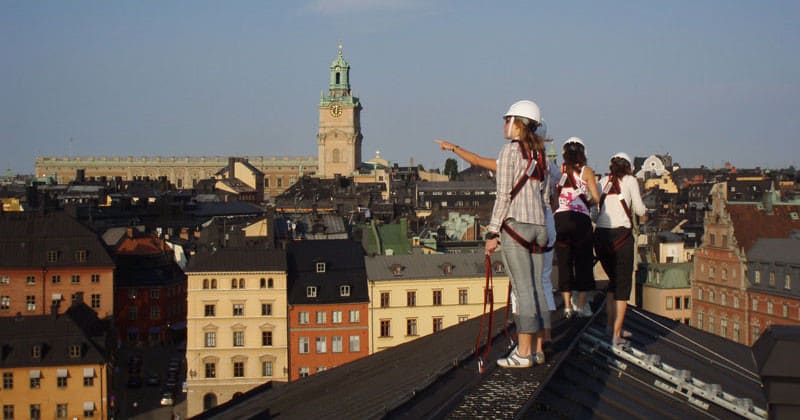
If you happen to be visiting Stockholm, Sweden, and want a bit of a unique adventure, there is a tour company named Takvandring, that will take you up onto the rooftops of buildings for a guided tour. These rooftop tours aren’t for the faint of heart, or people scared of heights, as you climb up onto the rooftops, only attached by a harness and a safety strap. But once you’re up there, you’re rewarded with spectacular views of the surrounding city — via CONTEMPORIST
Kviabryggja Prison in western Iceland doesn’t need walls, razor wire, or guard towers to keep the convicts inside. Alone on a wind-swept cape, the old farmhouse is bound by the frigid North Atlantic on one side and fields of snow-covered lava rock on another. To the east looms Snaefellsjokull, a dormant volcano blanketed by a glacier. There’s only one road back to civilization.
This is where the world’s only bank chiefs imprisoned in connection with the 2008 financial crisis are serving their sentences, Bloomberg Markets magazine reports in its forthcoming issue. Kviabryggja is home to Sigurdur Einarsson, Kaupthing Bank’s onetime chairman, and Hreidar Mar Sigurdsson, the bank’s former chief executive officer, who were convicted of market manipulation and fraud shortly before the collapse of what was then Iceland’s No.?1 lender. They spend their days doing laundry, working out in the jailhouse gym, and browsing the Internet. They and two associates incarcerated here — Magnus Gudmundsson, the ex-CEO of Kaupthing’s Luxembourg unit, and Olafur Olafsson, the No.?2 stockholder in the bank at the time of its demise — can even take walks outside, like Kviabryggja’s 19 other inmates, all of whom were convicted of nonviolent crimes — via redwolf.newsvine.com
British Columbia, Canada is known for many things: beautiful landscapes, great skiing, the 2010 Winter Olympics — and the human feet that have been washing up on its shores for the last nine years.
Since 2007, 12 human feet clad in running shoes have been found on the shores of British Columbia, from Jedediah Island to Botanical Beach. So far, the provincial coroner’s office has identified eight of the 12. Of those eight, two were pairs. The remaining lone feet, the coroner determined, belonged to men.
It had been nearly four years since a foot sighting, and then on 7 February a new one washed ashore, discovered by a hiker along Vancouver Island’s Botanical Beach. Five days later, another one appeared. The coroner’s office confirmed they were a pair — via redwolf.newsvine.com
To showcase the unique, eclectic culture of modern Britain, Heathrow Airport have teamed up with British Icon, Stephen Fry, to welcome arriving passengers to the UK — via Youtube
— via Youtube
It is not a great idea to carry a plank of wood down a busy sidewalk. Nor should you ride a horse while drunk, or handle a salmon under suspicious circumstances.
But should such antics be illegal? Still?
Thanks to centuries of legislating by Parliament, which bans the wearing of suits of armor in its chambers, Britain has accumulated many laws that nowadays seem irrelevant, and often absurd.
So voluminous and eccentric is Britain’s collective body of 44,000 pieces of primary legislation that it has a small team of officials whose sole task is to prune it.
Their work is not just a constitutional curiosity, but a bulwark against hundreds of years of lawmaking running out of control.
Over the centuries, rules have piled up to penalize those who fire a cannon within 300 yards of a dwelling and those who beat a carpet in the street — unless the item can be classified as a doormat and it is beaten before 8.00am.
To have a legal situation where there is so much information that you cannot sit down and comprehend it, does seem to me a serious problem,
said Andrew Lewis, professor emeritus of comparative legal history at University College London. I think it matters dreadfully that no one can get a handle on the whole of it.
Yet, as Professor Lewis also noted, many old laws have survived because crime and bad behaviour have, too.
One reason is that human nature doesn’t change much,
Professor Lewis said, though of course the institutions which we develop to protect, organize, and govern ourselves do change, and then it becomes necessary to adjust the existing law to practice
— via redwolf.newsvine.com
— via Youtube
You aren’t visiting the place you think you are — via Youtube

No trip to a new country would be complete without experiencing the culture that makes it unique. Indulging in the local food, attending festivals and visiting museums is easy but getting to know the language is a great way to take your understanding and appreciation to a whole new level. Hotel Club asked Australian illustrator and animator Jared Atkins to depict some typical as well as some of the more quirky Australian sayings you might come across on your next trip — via Hotel Club


 RSS – Posts