
Denver Zoo in Colorado is celebrating the birth of three Maned Wolf pups, born 1 May. The unnamed triplets, two males and one female, were born to mother, Adrianna, and father, Inigo, and are the first of their species to be born at the Zoo since 2009. All three pups were just given a clean bill of health by zoo veterinarians. Though the pups are not yet old enough to explore the outside world on their own yet, Zoo visitors might catch glimpses of them as their protective mother totes them from den to den inside the Wolf Pack Woods exhibit — via ZooBorns

I can’t afford those Dice Dragon holders, so I made my own, octopus edition — via Let’s Frick Frack
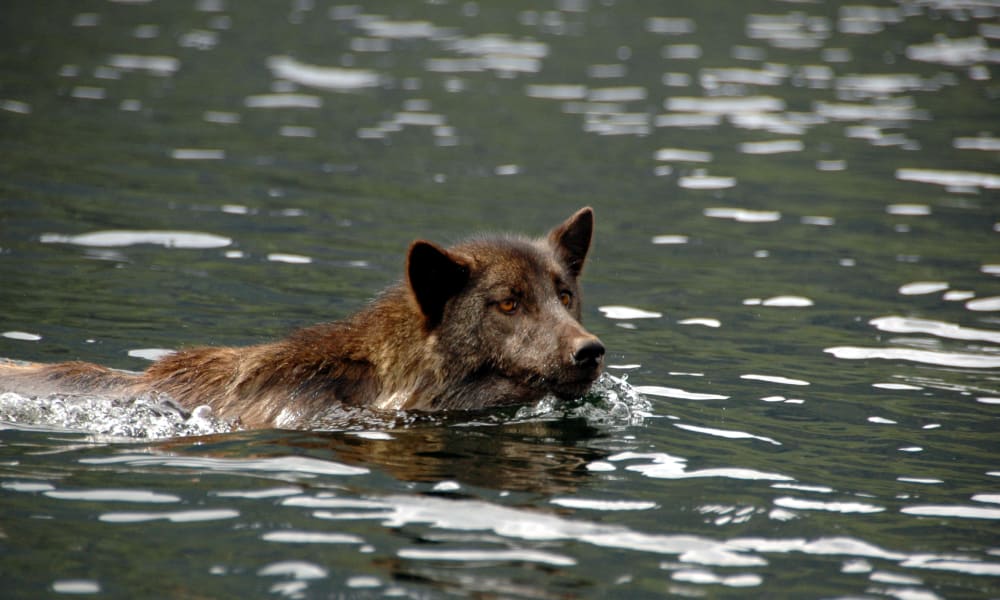
Photo Credit: Chris Darimont/Raincoast Conservation Project
Chester Starr of the Heiltsuk First Nation knows that the wolves of British Columbia come in two varieties: timber wolves on the mainland and coastal wolves on the islands. Genetic research has finally confirmed what Starr’s tribe has always known.
It was Starr’s traditional ecological knowledge
that initially inspired Polish Academy of Sciences researcher Astrid V Stronen and University of Calgary scientist Erin Navid to take a closer look at British Columbia’s wolves. They wanted to see whether the Heiltsuk Nation’s folk knowledge was reflected in the wolves’ genes.
The puzzling thing is that wolves are capable of moving over vast geographical distances. They can easily travel more than 70 kilometers per day without even breaking a sweat. They can cross valleys and mountains, and can swim across rivers and even small channels of sea. Yet Stronen, Navid, and colleagues found stark genetic distinctions among wolf groups in an area just 2000 square kilometers.
Why are there such clear genetic groupings among wolf groups who ought to be able to intermix?
According to the researchers, it’s all about what they eat. Despite the tiny distances between the mainland and the islands — sometimes less than 1500 meters of water — there are tremendous ecological distinctions. The mainland is rugged and is home to tons of wildlife, while the islands are less mountainous and host fewer species. On the mainland, grizzly bears compete with wolves, but on islands, wolves are the top dogs. On the mainland, wolves can feast on moose and mountain goats. On the islands, wolves rely on marine resources, like fish, for 85% of their diets — via redwolf.newsvine.com

Hi guys, I made myself an octopus backpack 🙂 — via Hello, T’is Jen

A fox is stealing dozens of shoes in a Leeds suburb and dumping them outside a woman’s house.
The problem has become so bad that Elaine Hewitt has been forced to put a shoe rack outside her home in Horsforth so neighbours can reclaim their missing footwear.
Ms Hewitt said the vulpine crimewave began a few months ago when she found a single shoe in her back garden.
The fox is now leaving a shoe a day, ranging from sandals to work boots.
Ms Hewitt, who has seen the fox carrying shoes, said the animal favoured leather footwear and the shoes are not chewed or damaged.
She believed it was stealing gardening shoes left outside people’s homes — via redwolf.newsvine.com
Asian small-clawed otter paws fly across the keyboard as part of their zoo enrichment. The otters are given the choice to play the keyboard or just sit back and enjoy the show—engaging their sight, touch, and hearing senses — via Youtube


Sniffing the Fluffy Dog and Sod Off, originally uploaded by Red Wolf
This baby fox cub was caught up in a cricket net. Luckily for him the Wildlife Aid animal rescue team came to set him free — via Youtube
A litter of cute dhole puppies make their debut at Howletts Wild Animal Park, near Canterbury — via Youtube

LegoKraken08, originally uploaded by Jack McKeen.


Feline Groovy T Shirt — via Ace Records

My finished octopi cross stitch. Aren’t they cute? — via coconutty grey

Five More Minutes, originally uploaded by Red Wolf
— via Youtube

Gallery quality Giclée print on natural white, matte, ultra smooth, 100% cotton rag, acid and lignin free archival paper using Epson K3 archival inks. Custom trimmed with 1” border for framing — via Society6
Faith in your spouse is a crucial element in a lasting, loving relationship. But when the doom of an entire kingdom rests on a single death defying act of ultimate heroism, having lots of practice definitely helps too. With their display of top form and precision I can only guess Princess Cadence and Shining Armour must have belonged to a cheer-leading team in their younger days. Either that or they participate in possibly the strangest version of Caber Toss.
Both figures and stand are carved out of Philippine mahogany while the gears and Cadence’s tiara are made of narra hardwood. They’re hand painted in enamel and with a protective flat lacquer top coat. The pair stand at 10″ from Shining Armour’s hoof to the tip of Cadence’s horn while the entire piece measures 13″ high, 7 1/2″ long and 3 1/2″ wide. It took 148 1/2 hours to complete — via Youtube

Octopodes, originally uploaded by Jennifer Raymond
Octopodes are a pair socks with stranded colour work on the foot, and helix knitting to stripe the ankle. All throughout, a pair of stripes shoot up the sides of the socks from toe to top, creating a strong visual line — via Ravelry
This guy came out of the booth to gift us a crab. What a friendly dude! — via Youtube

Mesker Park Zoo & Botanic Garden in Indiana has welcomed its first-ever Takin calf, a female named Ching Lan, which means beautiful orchid
in Chinese. In the wild, this little calf would be following her mother on steep mountain paths at three days-old. It looks like she’s practising those motor skills by sneaking up on mum — via ZooBorns


 RSS – Posts